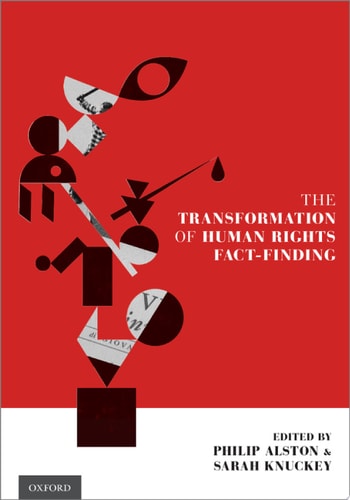
The Transformation of Human Rights Fact-finding
0
0
As an Amazon Associate and affiliate partner, Menrva Books earns from qualifying purchases. Learn more
Author Description
Fact-finding Is At The Heart Of Human Rights Advocacy, And Is Often At The Center Of International Controversies About Alleged Government Abuses. In Recent Years, Human Rights Fact-finding Has Greatly Proliferated And Become More Sophisticated And Complex, While Also Being Subjected To Stronger Scrutiny From Governments. Nevertheless, Despite The Prominence Of Fact-finding, It Remains Strikingly Under-studied And Under-theorized. Too Little Has Been Done To Bring Forth The Assumptions, Methodologies, And Techniques Of This Rapidly Developing Field, Or To Open Human Rights Fact-finding To Critical And Constructive Scrutiny. The Transformation Of Human Rights Fact-finding Offers A Multidisciplinary Approach To The Study Of Fact-finding With Rigorous And Critical Analysis Of The Field Of Practice, While Providing A Range Of Accounts Of What Actually Happens. It Deepens The Study And Practice Of Human Rights Investigations, And Fosters Fact-finding As A Discretely Studied Topic, While Mapping Crucial Transformations In The Field. The Contributions To This Book Are The Result Of A Major International Conference Organized By New York University Law School's Center For Human Rights And Global Justice. Engaging The Expertise And Experience Of The Editors And Contributing Authors, It Offers A Broad Approach Encompassing Contemporary Issues And Analysis Across The Human Rights Spectrum In Law, International Relations, And Critical Theory. This Book Addresses The Major Areas Of Human Rights Fact-finding Such As Victim And Witness Issues; Fact-finding For Advocacy, Enforcement, And Litigation; The Role Of Interdisciplinary Expertise And Methodologies; Crowd Sourcing, Social Media, And Big Data; And International Guidelines For Fact-finding.
Menrva's Summary
THE THESIS
How can the methodologies and underlying assumptions of human rights fact-finding be rigorously analyzed to improve the integrity and impact of international advocacy? Philip Alston and Sarah Knuckey, both distinguished scholars in international law and human rights, curate a collection of multidisciplinary essays that examine the evolution of investigative practices. The text argues that while fact-finding has become central to international relations, it lacks sufficient theoretical framework, necessitating a critical evaluation of how evidence is gathered, verified, and utilized in the face of increasing government scrutiny.
THE SCOPE MAP
What You Will Find
- Analysis of the integration of big data, social media, and crowdsourcing in modern investigations.
- Examination of victim and witness protection protocols within legal frameworks.
- Discussion of the intersection between international law, advocacy, and critical theory.
- Case studies derived from the NYU Center for Human Rights and Global Justice conference.
Scope Limits
- The text does not provide a universal manual for field investigators but focuses on the theoretical and structural evolution of the discipline.
- It does not cover specific, localized political conflicts in isolation, but rather uses them to illustrate broader methodological trends.
THE AUTHORITY PERSPECTIVE
Experts identify this work as a foundational text for understanding the professionalization and academic formalization of human rights investigations. Readers frequently note the academic density of the prose, which is tailored for legal scholars, practitioners, and students of international relations.
Page Count:
448
Publication Date:
2015-01-01
Publisher:
Oxford University Press
ISBN-10:
0190239506
ISBN-13:
9780190239503
Global Justice
Human rights
Sociology
International Law
Community Tags
Similar Books