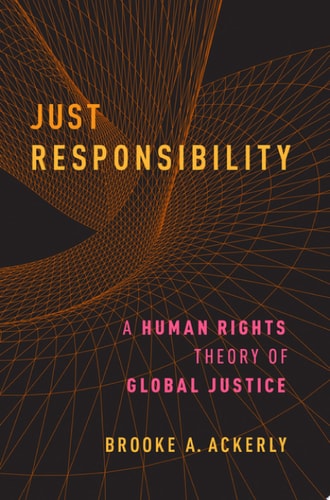
Just Responsibility: A Human Rights Theory of Global Justice
0
0
As an Amazon Associate and affiliate partner, Menrva Books earns from qualifying purchases. Learn more
Author Description
It has been well-established that many of the injustices that people around the world experience every day, from food insecurity to unsafe labor conditions and natural disasters, are the result of wide-scale structural problems of politics and economics. These are not merely random personal problems or consequences of bad luck or bad planning. Confronted by this fact, it is natural to ask what should or can we do to mitigate everyday injustices? In one sense, we answer this question when we buy the local homeless street newspaper, decide where to buy our clothes, remember our reusable bags when we shop, donate to disaster relief, or send letters to corporations about labor rights. But given the global scale of injustices related to poverty, environmental change, gender, and labor, can these individual acts really impact the seemingly intractable global social, political, and economic structures that perpetuate and exacerbate them? Moreover, can we respond to injustices in the world in ways that do more than just address their consequences?In this book, Brooke A. Ackerly both answers the question of what should we do, and shows that it's the wrong question to ask. To ask the right question, we need to ground our normative theory of global justice in the lived experience of injustice. Using a feminist critical methodology, she argues that what to do about injustice is not just an ethical or moral question, but a political question about assuming responsibility for injustice, regardless of our causal responsibility and extent of our knowledge of the injustice. Furthermore, it is a matter that needs to be guided by principles of human rights. As she argues, while many understand human rights as political goals or entitlements, they can also guide political strategy. Her aims are twofold: to present a theory of what it means to take responsibility for injustice and for ensuring human rights, as well as to develop a guide for how to take responsibility in ways that support
Menrva's Summary
THE THESIS
This book investigates how individuals can effectively address global structural injustices by shifting the focus from personal moral choices to a political framework of collective responsibility. Brooke A. Ackerly, a professor of political science, utilizes a feminist critical methodology to analyze the intersection of human rights and political strategy. She argues that responsibility for injustice is not contingent upon direct causal links or personal knowledge, but rather functions as a necessary political commitment to human rights principles.
THE SCOPE MAP
What You Will Find
- A theoretical framework for understanding responsibility in the context of global structural problems.
- An analysis of human rights as a tool for political strategy rather than just an end goal.
- A methodology grounded in the lived experiences of those facing systemic injustice.
Scope Limits
- The text does not provide a prescriptive list of individual consumer actions or charitable activities.
- It does not focus on the legal mechanisms of international courts or specific treaty enforcement.
THE AUTHORITY PERSPECTIVE
Scholars in political theory and human rights frequently cite this work for its rigorous application of feminist methodology to global justice issues. Readers often note the academic density of the prose, which is intended for an audience familiar with normative political theory and social justice discourse.
Page Count:
311
Publication Date:
2018-01-01
Publisher:
Oxford University Press
ISBN-10:
0190662964
ISBN-13:
9780190662967
Social justice
Human rights
Global Justice
Feminist Theory
Ethics
International Security
Community Tags
Other Editions(2)
Similar Books













Reader Comments
Share Your Thoughts
No comments yet. Be the first to share your thoughts!