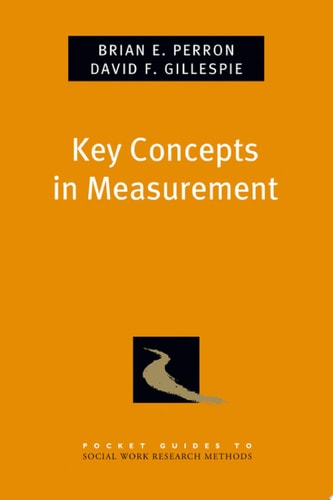
Key Concepts in Measurement
0
0
As an Amazon Associate and affiliate partner, Menrva Books earns from qualifying purchases. Learn more
Author Description
Measurement refers generally to the process of assigning a numeric value to, or ordering characteristics or traits of, entities under study. Measurement is necessary for building and testing theory, specifying problems, and defining goals. It is arguably one of the most important and diffcult tasks in social work research. Social work researchers who are not expert in developing, selecting, and using measures will not be able to contribute maximally to the social work knowledge base. Such knowledge and skills related to measurement ultimately determines the extent to which social work research can effectively inform social policy and social work interventions.This book is to serve as a guide for developing, selecting, and using measures in social work research. In particular, this book provides a detailed review of contemporary validity theory; an update on the major issues of reliability; common errors in measurement of latent variables; and suggestions on measurement of social networks and collectives.An important theme of this book is the focus on the creative potential of measurement - that is, helping social work researchers think about the wide variety of ways that social work concepts can be measured. Reflecting on these differences raises questions about underlying assumptions that in turn inspires creative theoretical insights. Rather than seeing measurement as simply a task to be completed in the research process, we will encourage the reader to think creatively about measurement and theory.This book also addresses the interdependency of measurement and theory construction. In other words, this book covers how measurement and theory are connected in two different ways. First, every measure has its own working theory that relates the measure to the concept being measured. Second, theory construction is dependent on measurement. What we learn using a given measure could be different if a concept was measured in a different way.
Menrva's Summary
THE THESIS
This book investigates the critical role of measurement in social work research, addressing how the process of assigning numeric values to traits informs theory construction and intervention efficacy. Authors Brian E. Perron and David F. Gillespie, both established scholars in social work research methods, provide a framework for developing and selecting measures. They argue that measurement is not merely a technical task but a creative process that directly influences the depth of theoretical insights and the quality of social policy outcomes.
THE SCOPE MAP
What You Will Find
- Contemporary validity theory and reliability updates
- Analysis of common errors in latent variable measurement
- Methodologies for measuring social networks and collectives
- Frameworks for the interdependency between measurement and theory
Scope Limits
- Does not provide a comprehensive catalog of all existing social work scales
- Does not cover qualitative research methods or ethnographic data collection
THE AUTHORITY PERSPECTIVE
Experts identify this text as a specialized resource for graduate students and practitioners seeking to refine their quantitative research skills. Readers frequently note the academic density of the prose, which serves as a focused guide for those already familiar with basic social work research principles.
Page Count:
160
Publication Date:
2015-01-01
Publisher:
Oxford University Press
ISBN-10:
0190235977
ISBN-13:
9780190235970
Introduction to Social WorkWelfare
Research Methods
Social Work
Academic
Methodology
Measurement Theory
Social Science
Community Tags
Other Editions(2)

Similar Books















Reader Comments
Share Your Thoughts
No comments yet. Be the first to share your thoughts!