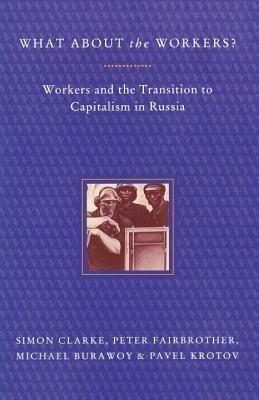
What About the Workers?
0
0
As an Amazon Associate and affiliate partner, Menrva Books earns from qualifying purchases. Learn more
Author Description
Most writing on the dramatic events in the former Soviet Union has been based on the assumption that Russia is engaged in a transition from “state socialism” to capitalism, and focuses on political and ideological debates formulated in these terms. This book questions whether Russia is in transition to capitalism and looks behind the political and ideological debates to focus on the development of the social relations of production, and on the class struggles to which these give rise. Simon Clarke introduces the book with an examination of the crisis of state socialism, in order to identify the dynamic of change in contemporary Russia. Michael Burawoy and Pavel Krotov develop a detailed case study of one Russian enterprise, which is followed by an analysis of the role of the trade unions in the Soviet system by Simon Clarke and Peter Fairbrother, on the basis of which they develop an analytical account of the development of the workers’ movement in Russia since 1987. Simon Clarke concludes the book with a detailed examination of struggles around privatization. The common conclusion is that beneath the political turmoil the dominant class has renewed and restructured itself, but has not managed to overcome the challenge presented by the working class. The fragmentation and atomization of the working class remains a problem, but the struggle over the transformation of class relations is only just beginning.
Menrva's Summary
THE THESIS
This book challenges the prevailing assumption that Russia is undergoing a transition from state socialism to capitalism, instead focusing on the development of production relations and class struggles. The author examines the crisis of state socialism to understand contemporary Russia's dynamics. It presents a case study of a Russian enterprise, followed by an analysis of trade unions and the workers' movement since 1987. The book concludes with an examination of privatization struggles, suggesting that while the dominant class has restructured, the challenge from the working class is ongoing.
THE SCOPE MAP
- Analysis of the crisis of state socialism.
- Case study of a Russian enterprise focusing on social relations of production.
- Examination of the role of trade unions in the Soviet system.
- Development of the workers' movement in Russia since 1987.
- Detailed examination of struggles around privatization.
- Conclusion on the restructuring of the dominant class and ongoing working-class challenges.
THE AUTHORITY PERSPECTIVE
This book is regarded as a critical examination of the post-Soviet transition, moving beyond political and ideological debates to analyze the underlying economic and class structures. It is noted for its focus on the development of the social relations of production and the class struggles arising from them. The collective analysis suggests that despite political turmoil, the dominant class has reformed itself, but the fundamental challenge posed by the working class remains unresolved and is only beginning to unfold.
Page Count:
258
Publication Date:
1993-01-01
ISBN-10:
0860916669
ISBN-13:
9780860916666
Politics
Science
Non-Fiction
Economics
History
Community Tags
Similar Books