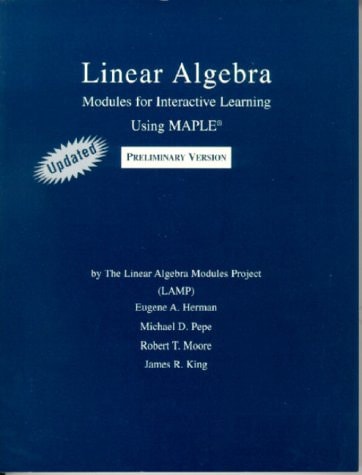
Linear Algebra: Modules for Interactive Learning Using Maple
0
0
As an Amazon Associate and affiliate partner, Menrva Books earns from qualifying purchases. Learn more
Author Description
Linear Algebra: Modules for Interactive Learning Using Maple (R) is organized into a collection of twenty-eight extensive (and intensive) modules, which must be used in conjunction with Release 5 of Maple V (R). Each module is divided into an interactive Tutorial followed by a rich and substantial collection of Problems. Linear Algebra: Modules for Interactive Learning Using Maple (R) has been carefully designed to help students develop their geometric intuition and deepen their understanding of linear algebra concepts and methods. These modules support both individual work and interactive collaboration. They can be used as a supplement in a traditional lecture course, or in a lab-only format. Due to their versatility, they can be easily adapted to a variety of curricula, institutions, and styles of teaching. Goals of the Modules 1. To help students develop their geometric intuition about the concepts of linear algebra; 2. To deepen students' understanding of the algebraic formulation of these concepts and to strengthen their ability to manipulate concepts; 3. To help students gain an appreciation of how the concepts and methods of linear algebra are applied. Structure of the Modules Each module is divided into two main parts, the Tutorial and the Problems: The Tutorial is further divided into sections and consists of an interlaced text (usually brief), examples and demonstrations, and exercises (with answers provided in closed sections). The Problems are all intended to be fairly substantial, as they provide the work on which students will be graded. They include explorations, applications, constructions (e.g., of specified types of matrices or specified pictures or animations), counter-examples, short essays, proofs, true/false questions, and many challenging computations. Each module is a Maple worksheet that is to be used in conjunction with Release 5 of Maple V (R).
Menrva's Summary
THE THESIS
This text investigates how interactive computational tools can enhance the pedagogical delivery of linear algebra concepts. The authors, Eugene A. Herman, James R. King, Michael D. Pepe, and Robert Y. Moore, utilize the Maple V software environment to bridge the gap between abstract algebraic formulation and geometric intuition. By providing a structured series of modules, the authors argue that active engagement with software-based demonstrations and problem sets leads to a more robust understanding of matrix theory and linear transformations.
THE SCOPE MAP
What You Will Find
- Twenty-eight comprehensive modules covering core linear algebra topics.
- Integration with Maple V Release 5 software for computational modeling.
- Interactive tutorials featuring demonstrations and interlaced exercises.
- Substantial problem sets including proofs, applications, and construction tasks.
THE AUTHORITY PERSPECTIVE
Educators frequently cite this work as a foundational resource for integrating computer algebra systems into undergraduate mathematics curricula. The text is noted for its rigorous approach to balancing theoretical proofs with practical, software-driven computation.
Page Count:
326
Publication Date:
1999-01-01
Publisher:
Addison-Wesley
ISBN-10:
0201648466
ISBN-13:
9780201648461
textbook
Education
Computer Science
Maple Computer Program
Mathematics
Linear Algebra
Community Tags
Similar Books




Reader Comments
Share Your Thoughts
No comments yet. Be the first to share your thoughts!