Maple Animation
0
0
As an Amazon Associate and affiliate partner, Menrva Books earns from qualifying purchases. Learn more
Author Description
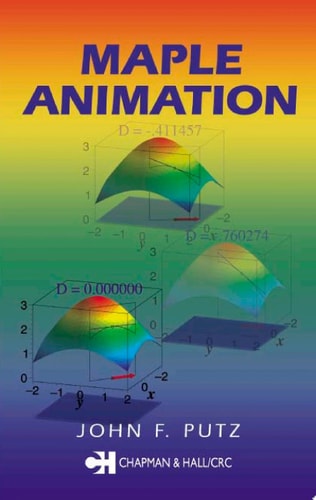
There is nothing quite like that feeling you get when you see that look of recognition and enjoyment on your students' faces. Not just the strong ones, but everyone is nodding in agreement during your first explanation of the geometry of directional derivatives. If you have incorporated animated demonstrations into your teaching, you know how effective they can be in eliciting this kind of response. You know the value of giving students vivid moving images to tie to concepts. But learning to make animations generally requires extensive searching through a vast computer algebra system for the pertinent functions. Maple Animation brings together virtually all of the functions and procedures useful in creating sophisticated animations using Maple 7, 8, or 9 and it presents them in a logical, accessible way. The accompanying downloadable resources provide all of the Maple code used in the book, including the code for more than 30 ready-to-use demonstrations. From Newton's method to linear transformations, the complete animations included in this book allow you to use them straight out of the box. Careful explanations of the methods teach you how to implement your own creative ideas. Whether you are a novice or an experienced Maple user, Maple Animation provides the tools and skills to enhance your teaching and your students' enjoyment of the subject through animation.
Menrva's Summary
THE THESIS
This book investigates how educators can effectively utilize the Maple computer algebra system to create dynamic animations that clarify complex mathematical concepts for students. Author John F. Putz, an experienced educator, provides a structured framework for integrating visual demonstrations into the classroom. By consolidating disparate functions and procedures into a single, accessible guide, the text aims to lower the barrier to entry for instructors seeking to enhance their pedagogical toolkit with computational visualization.
THE SCOPE MAP
What You Will Find
- Comprehensive documentation of Maple functions and procedures for animation development.
- Step-by-step tutorials for implementing animations in Maple 7, 8, and 9.
- A library of over 30 ready-to-use demonstration scripts covering topics like Newton's method and linear transformations.
- Methodological guidance on transitioning from using pre-built animations to creating original, custom-coded visual aids.
THE AUTHORITY PERSPECTIVE
Instructors frequently cite this text as a practical, time-saving resource for bridging the gap between abstract mathematical theory and visual representation. Experts highlight the book's utility as both a ready-to-use library of demonstrations and a foundational guide for developing custom computational teaching tools.
Page Count:
232
Publication Date:
2018-01-01
Publisher:
Chapman and Hall/CRC
ISBN-10:
0203503139
ISBN-13:
9780203503133
Education
Computer Animation
Software
Maple Computer Program
Computer Science
Teaching Methods
Mathematics
Community Tags
Other Editions(7)



Similar Books




Reader Comments
Share Your Thoughts
No comments yet. Be the first to share your thoughts!