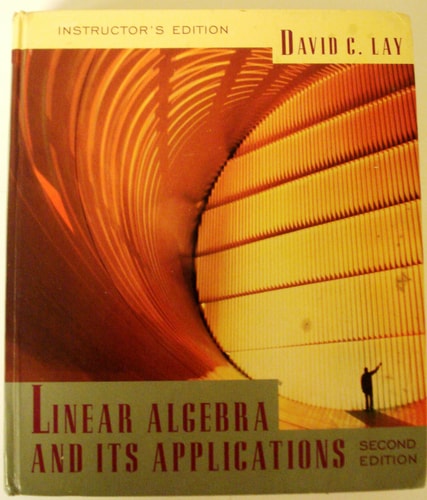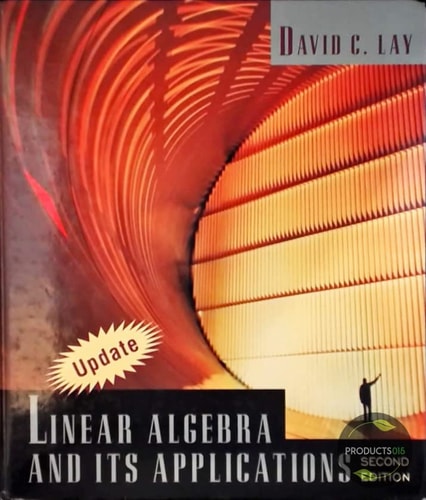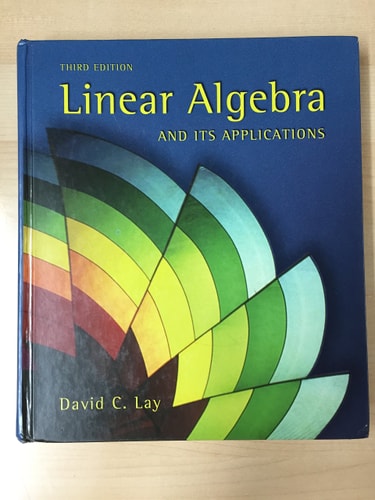
Linear Algebra and Its Applications
Author Description
Linear algebra is relatively easy for students during the early stages of the course, when the material is presented in a familiar, concrete setting. But when abstract concepts are introduced, students often hit a brick wall. Instructors seem to agree that certain concepts (such as linear independence, spanning, subspace, vector space, and linear transformations), are not easily understood, and require time to assimilate. Since they are fundamental to the study of linear algebra, students' understanding of these concepts is vital to their mastery of the subject. Lay introduces these concepts early in a familiar, concrete Rn setting, develops them gradually, and returns to them again and again throughout the text. Finally, when discussed in the abstract, these concepts are more accessible.
Menrva's Summary
THE THESIS
This text investigates how to bridge the gap between concrete computational methods and abstract mathematical theory in linear algebra. David C. Lay, a professor of mathematics, utilizes a pedagogical framework that introduces complex concepts within the familiar setting of Rn before transitioning to abstract vector spaces. By revisiting these fundamental ideas throughout the curriculum, the author ensures that students build a robust conceptual foundation before tackling advanced theoretical applications.
THE SCOPE MAP
What You Will Find
- Comprehensive coverage of linear independence, spanning, and subspaces.
- Methodologies for understanding linear transformations and vector spaces.
- Concrete examples transitioning into abstract mathematical proofs.
- Pedagogical strategies for mastering fundamental algebraic concepts.
THE AUTHORITY PERSPECTIVE
Instructors and students frequently cite this text as a standard resource for undergraduate linear algebra due to its accessible approach to abstract concepts. Experts highlight the book's effectiveness in helping students overcome common conceptual hurdles through its iterative teaching method.
Page Count:
576
Publication Date:
2002-07-18
Publisher:
Addison Wesley
ISBN-10:
0201709708
ISBN-13:
9780201709704
Science
textbook
Mathematics
Education
Linear Algebra
Community Tags
Similar Books