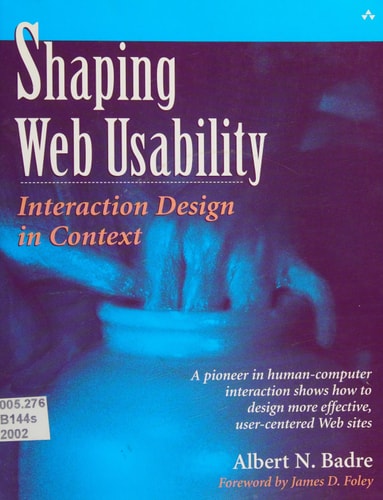
Shaping Web Usability: Interaction Design in Context
0
0
As an Amazon Associate and affiliate partner, Menrva Books earns from qualifying purchases. Learn more
Author Description
It's no longer enough to make your site easy to learn and use: Web designers need to help their users feel comfortable with every aspect of their site interactions: physical, mental, and emotional. Drawing upon advanced research in psychology and human-computer interfaces -- as well as extensive practical Web design experience -- Albert N. Badre shows precisely how to accomplish this. Badre goes beyond "mere usability," introducing a complete, Web-specialized framework that lets you "design for context," taking into account every aspect of the Web environment. Shaping Web Usability begins by reviewing essential human-computer interaction principles for the Web; then outlines a usability strategy that takes multiple contexts into account: extrinsic design, users, genre, site, and page. Badre offers deep insight into Web users themselves: their skill levels, personalities, and demographics; and presents a full chapter on the unique needs of older Web users. Along the way, he addresses the key issues that make Web usability so challenging, including security and privacy, platform independence, dynamic content, compatibility, and navigation. You'll learn how to ensure that aesthetics and usability complement each other; how to extend usability to handheld devices; and how to evaluate Web usability most effectively. For all Web designers, developers, usability specialists, marketers, and others concerned with the Web user experience.
Menrva's Summary
THE THESIS
This book investigates how web designers can move beyond basic usability to create digital environments that address the physical, mental, and emotional needs of users. Albert N. Badre, an expert in human-computer interaction, synthesizes psychological research with practical design experience to propose a framework for context-aware web development. He argues that effective design must account for the specific variables of the web environment, including user demographics, site genre, and technical constraints.
THE SCOPE MAP
What You Will Find
- A multi-dimensional usability framework covering extrinsic design, user profiles, and site architecture.
- Analysis of specific user demographics, including a dedicated focus on the requirements of older web users.
- Methodologies for balancing aesthetic appeal with functional navigation and accessibility.
- Strategies for addressing modern web challenges such as privacy, dynamic content, and cross-platform compatibility.
THE AUTHORITY PERSPECTIVE
Experts recognize this work as a foundational text for understanding the intersection of cognitive psychology and web interface design. Practitioners frequently note that the book provides a structured, academic approach to user experience that remains relevant for developers and designers alike.
Page Count:
328
Publication Date:
2002-01-23
Publisher:
Addison-Wesley Professional
ISBN-10:
0201729938
ISBN-13:
9780201729931
Psychology
Technology
Web Design
World Wide Web
Community Tags
Similar Books