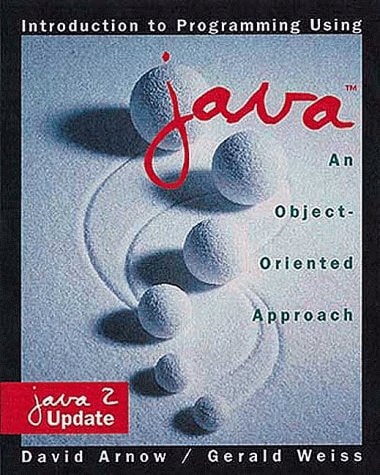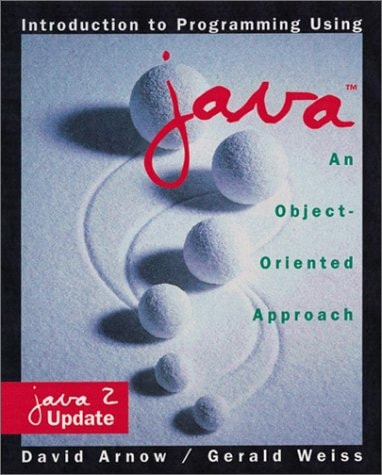
Introduction to Programming Using Java: An Object-Oriented Approach
0
0
As an Amazon Associate and affiliate partner, Menrva Books earns from qualifying purchases. Learn more
Author Description
This introductory programming in Java book offers an object-oriented approach, introducing the concepts of object, class, and message as early as the first chapter. The code has been thoroughly updated to the Java 2 platform. This object-oriented approach is used throughout the text, as students learn the fundamentals of object-oriented programming along with the basics of imperative programming. The authors place a strong emphasis on the software development process, presenting a clear and usable procedure for solving problems by developing classes that is used throughout the text. In addition, each chapter has an optional supplemental section that introduces graphical user interface (GUI) concepts through the medium of the Java AWT. Java's support for GUI and network programming makes a great setting for diverse programming examples: a calculator, a strategy game, reading the Dow Jones from Yahoo!, a Web surveyor application, scheduling songs for a radio station, as well as traditional payroll and student GPA computations. Working with these and other examples, students learn to think like a programmer, analyze problems, devise solutions, design classes, and write code.
Menrva's Summary
THE THESIS
How can students effectively master the fundamentals of programming by adopting an object-oriented mindset from the very beginning of their education? Authors David M. Arnow and Gerald Weiss present a pedagogical framework that prioritizes the concepts of objects, classes, and messages immediately. By integrating imperative programming basics with object-oriented design principles, the text provides a structured methodology for software development that remains consistent throughout the learning process.
THE SCOPE MAP
What You Will Find
- Comprehensive coverage of the Java 2 platform standards and syntax.
- A structured software development procedure for problem-solving and class design.
- Supplemental modules focused on graphical user interface (GUI) development using Java AWT.
- Practical application examples ranging from financial data retrieval to interactive strategy games.
THE AUTHORITY PERSPECTIVE
Educators and students frequently note the text's emphasis on practical application, which helps bridge the gap between theoretical concepts and functional code. Experts highlight this as a foundational resource for those seeking to understand the transition from procedural logic to object-oriented architecture.
Page Count:
800
Publication Date:
2001-06-12
Publisher:
Addison Wesley
ISBN-10:
0201751593
ISBN-13:
9780201751598
Programming
Computer Science
Java
textbook
Education