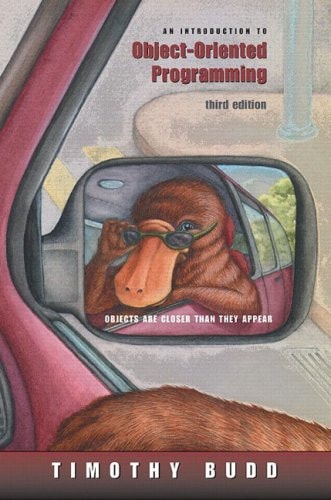
An Introduction to Object-Oriented Programming
0
0
As an Amazon Associate and affiliate partner, Menrva Books earns from qualifying purchases. Learn more
Author Description
In An Introduction to Object-Oriented Programming, Timothy Budd provides a language-independent presentation of object-oriented principles, such as objects, methods, inheritance (including multiple inheritance) and polymorphism. Examples are drawn from several different languages, including (among others) C++, C#, Java, CLOS, Delphi, Eiffel, Objective-C and Smalltalk. By examining many languages, the reader is better able to appreciate the general principles that lie beyond the syntax of the individual languages.
Menrva's Summary
THE THESIS
This text investigates the fundamental principles of object-oriented programming by abstracting core concepts away from the syntax of specific programming languages. Timothy Budd, a recognized educator in computer science, utilizes a comparative approach to demonstrate how concepts like inheritance, polymorphism, and encapsulation function across diverse environments. By analyzing multiple languages, the book establishes a conceptual framework that allows students to understand the underlying logic of object-oriented design regardless of the specific implementation language used.
THE SCOPE MAP
What You Will Find
- Core object-oriented principles including objects, methods, inheritance, and polymorphism
- Comparative analysis of C++, C#, Java, CLOS, Delphi, Eiffel, Objective-C, and Smalltalk
- Language-independent design patterns and structural methodologies
- Theoretical foundations of class hierarchies and dynamic binding
THE AUTHORITY PERSPECTIVE
Experts frequently cite this work as a foundational text for students seeking to understand the theoretical underpinnings of object-oriented programming. Readers often note that the comparative approach provides a clear perspective on how different languages handle similar design challenges.
Page Count:
640
Publication Date:
2001-01-01
Publisher:
Pearson
ISBN-10:
0201760312
ISBN-13:
9780201760316
textbook
Programming
Computer Science
Software Engineering