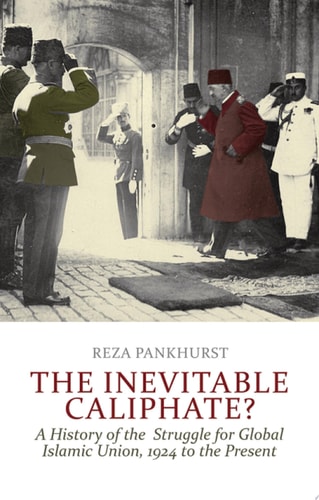
The Inevitable Caliphate?: A History of the Struggle for Global Islamic Union, 1924 to the Present
0
0
As an Amazon Associate and affiliate partner, Menrva Books earns from qualifying purchases. Learn more
Author Description
While in the West 'the Caliphate" evokes overwhelmingly negative images, throughout Islamic history it has been regarded as the ideal Islamic polity. In the wake of the "Arab Spring" and the removal of long-standing dictators in the Middle East, in which the dominant discourse appears to be one of the compatibility of Islam and democracy, reviving the Caliphate has continued to exercise the minds of its opponents and advocates. Reza Pankhurst's book contributes to our understanding of Islam in politics, the path of Islamic revival across the last century and how the popularity of the Caliphate in Muslim discourse waned and later re-emerged. Beginning with the abolition of the Caliphate, the ideas and discourse of the Muslim Brotherhood, Hizb ut-Tahrir, al-Qaeda and other smaller groups are then examined. A comparative analysis highlights the core commonalities as well as differences between the various movements and individuals, and suggests that as movements struggle to re-establish a polity which expresses the unity of the ummah (or global Islamic community), the Caliphate has alternatively been ignored, had its significance minimised or denied, reclaimed and promoted as a theory and symbol in different ways, yet still serves as a political ideal for many.
Menrva's Summary
THE THESIS
This book investigates the historical trajectory and political evolution of the Caliphate as a concept and goal within Islamic movements from its 1924 abolition to the contemporary era. Reza Pankhurst, a researcher in political science and Islamic history, utilizes a comparative framework to analyze how various organizations have interpreted the necessity of a unified Islamic polity. The text examines the shifting discourse surrounding the Caliphate, tracing its decline in popularity and its subsequent resurgence as a potent political symbol in the wake of regional instability.
THE SCOPE MAP
What You Will Find
- A historical analysis of the abolition of the Caliphate in 1924 and its aftermath.
- Comparative studies of major movements including the Muslim Brotherhood, Hizb ut-Tahrir, and al-Qaeda.
- An examination of the intersection between Islamic revivalism and modern political discourse.
Scope Limits
- The text does not provide a comprehensive theological treatise on the Caliphate but focuses primarily on its political and ideological utility.
- It does not offer predictive modeling for future geopolitical outcomes in the Middle East.
THE AUTHORITY PERSPECTIVE
Scholars and regional analysts frequently cite this work as a useful resource for understanding the intellectual history of modern Islamist political thought. Readers often note the clarity with which the author distinguishes between the diverse ideological approaches of various movements regarding the concept of global Islamic unity.
Page Count:
292
Publication Date:
2013-01-01
Publisher:
Oxford University Press
ISBN-10:
0190257601
ISBN-13:
9780190257606
History
Middle Eastern
Radicalism
Caliphate
Religion and Politics
Islamic Studies
Community Tags
Similar Books