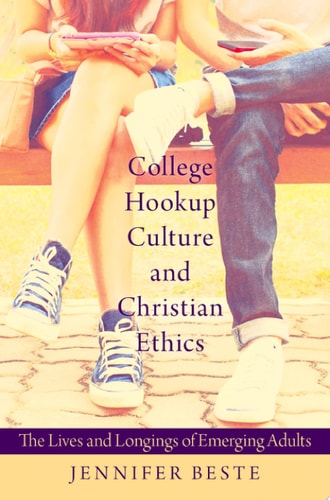
College Hookup Culture and Christian Ethics: The Lives and Longings of Emerging Adults
0
0
As an Amazon Associate and affiliate partner, Menrva Books earns from qualifying purchases. Learn more
Author Description
Today's Christian adolescents and young adults have grown up with fiercely competing narratives about sex, relationships, and fulfillment. Within a Christian world of church services and formal religious education, they have been warned repeatedly about the dangers (or sinfulness) of premarital sex. At the same time, popular culture has inundated them with a very different message: casual sex is fun, thrilling, expected, and no big deal. Jennifer Beste calls into question the widespread assumption that the media's narrative of sex is positively liberating, while a Christian theological account is repressive, sex-negative, and altogether irrelevant. Her argument is based on a qualitative analysis of college students' own accounts of their social and sexual culture. She draws on the reflections of 126 undergraduate students who set out as sober ethnographers to observe and analyze peers at college parties. Overwhelmingly, undergraduates' perspectives challenge a neutral or even benevolent view of hookup culture embraced by some sociologists, "sex-positive" feminists, and popular culture in general. Beste goes on to share her own and her students' theological and ethical reflections as they explored the intersection between their social reality, the Christian tradition, and other academic disciplines, and sought to discern more deeply: what it means to become fully human; what constitutes happiness and fulfillment; and how to envision and create more socially and sexually just communities.
Menrva's Summary
THE THESIS
This book investigates the disconnect between secular hookup culture and Christian ethical frameworks in the lives of contemporary college students. Jennifer Erin Beste, a scholar of theology and ethics, utilizes qualitative data gathered from 126 undergraduate students to examine how emerging adults navigate competing narratives regarding intimacy and fulfillment. Her argument challenges the assumption that secular hookup culture is inherently liberating, proposing instead that Christian theological perspectives offer a more robust framework for understanding human flourishing and social justice.
THE SCOPE MAP
What You Will Find
- Qualitative analysis of student-led ethnographic observations of college social environments
- Comparative study of secular media narratives versus Christian theological teachings on sexuality
- Ethical frameworks for evaluating personal fulfillment and community health
Scope Limits
- The study focuses primarily on the experiences of students within a Christian-influenced educational context
- It does not provide a comprehensive sociological survey of all secular university campuses
THE AUTHORITY PERSPECTIVE
Scholars and educators frequently cite this work as a significant contribution to the dialogue between theology and contemporary sociological trends in higher education. Readers often note the accessible yet rigorous nature of the qualitative research, which provides a nuanced look at the lived experiences of students navigating complex moral landscapes.
Page Count:
376
Publication Date:
2017-12-01
Publisher:
Oxford University Press
ISBN-10:
0190268506
ISBN-13:
9780190268503
Religion
Theology
Emerging Adulthood
Christian ethics
Sociology
Higher Education
Community Tags
Other Editions(2)
Similar Books