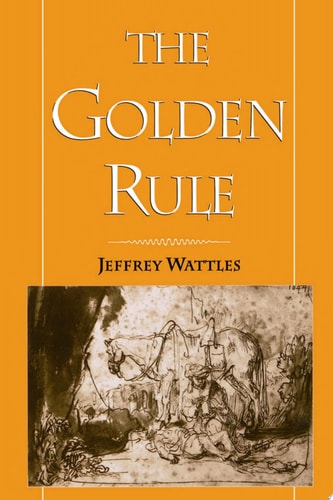
The Golden Rule
0
0
As an Amazon Associate and affiliate partner, Menrva Books earns from qualifying purchases. Learn more
Author Description
In an age plagued by selfishness, materialism, and violence, ethicists feel impelled to find a universal system of values. To arrive at such a "rule" requires that they struggle with a series of seemingly irreconcilable questions. First, are universal values possible in a pluralistic world, and how does one do justice to both human equality and to individual and cultural differences? How is one to understand the interface between religious moral teachings and the ethics of secular humanism? Finally, can such a system integrate moral intuition and moral reason? In the first scholarly book in English on the golden rule since the seventeenth century, Jeffrey Wattles demonstrates how a clear understanding of the psychological, philosophical, and religious ramifications of the rule can form the synthesis needed to solve these dilemas. The golden rule, "do to others as you would have others do to you," is widely assumed to have a single meaning, shared by virtually all the world's religions. It strikes the average person as intuitively true, though most modern philosophers reject it or recast it in more rational form. Wattles surveys the history of the golden rule and its spectrum of meanings in diverse contexts, ranging from Confusius to Plato and Aristotle, from classical Jewish literature to the New Testament. He also considers medieval, Reformation, and modern theological and philosophical responses and objections to the rule, as well as how some early twentieth-century American leaders have tried to use the rule. Wattles draws these diverse interpretation into a synthesis that responds, at the psychological, philosophical, and religious levels, to the challenges to moral living in any given culture. Emotionally, the rules counsels consideration for others feelings by asking that "you place yourself in their shoes." Intellectually, it activates moral thinking about what is fair. At the same time, it retains a spiritual appeal as "the principle of the practice of the f
Menrva's Summary
THE THESIS
Can the golden rule serve as a universal ethical framework capable of reconciling moral intuition with rational thought in a pluralistic society? Jeffrey Wattles, a scholar of ethics and religion, investigates the historical, psychological, and philosophical dimensions of the golden rule. He argues that by synthesizing diverse religious and secular interpretations, the rule can function as a viable, coherent guide for moral conduct in contemporary culture.
THE SCOPE MAP
What You Will Find
- A comprehensive historical survey of the golden rule from Confucius to modern thinkers.
- An analysis of the intersection between religious moral teachings and secular humanism.
- A psychological framework for applying the rule through empathy and perspective-taking.
Scope Limits
- The text does not provide a prescriptive manual for specific modern policy decisions.
- It does not attempt to resolve every theological debate regarding the origins of moral law.
THE AUTHORITY PERSPECTIVE
Scholars and ethicists recognize this work as a foundational, scholarly examination of a principle often oversimplified in popular discourse. Readers frequently note the academic density of the prose, which provides a rigorous intellectual history for those interested in the evolution of moral philosophy.
Page Count:
267
Publication Date:
1996-01-01
Publisher:
Oxford University Press
ISBN-10:
0190079126
ISBN-13:
9780190079123
Philosophy
Religion
Ethics
Christian ethics
History of Ideas
Jewish Ethics
Social Philosophy
Moral Philosophy
Theology
Religious
Community Tags
Similar Books