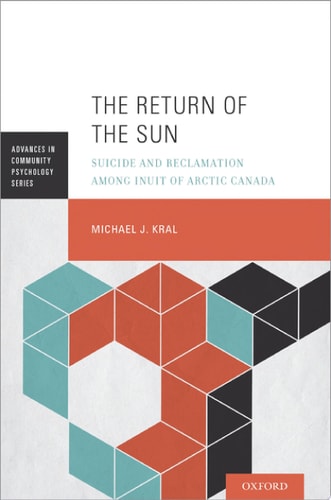
The Return of the Sun: Suicide and Reclamation Among Inuit of Arctic Canada
0
0
As an Amazon Associate and affiliate partner, Menrva Books earns from qualifying purchases. Learn more
Author Description
Inuit have among the highest suicide rates in the world - ten times the national average. Inuit narratives of suicide provide clues as to what can and in some cases has been done to combat the problem, but until recently they have not circulated far beyond Inuit communities themselves. At the same time, academic researchers have studied suicide among Indigenous peoples, but have stopped short of analyzing narrative accounts for their themes of cultural survival.Based on two decades of participatory action and ethnographic research, The Return of the Sun is a historical and anthropological examination of suicide among Inuit youth in Arctic Canada. Conceptualizing suicide among Inuit as a response to colonial disruption of family and interpersonal relationships and examining how the community has addressed the issue, Kral draws on research from psychology, anthropology, Indigenous studies, and social justice to understand and address this population. Central to the book are narrative accounts by Inuit of their experiences and perceptions of suicide, and the lives of youth and their community action for change. As these Indigenous community success stories have not previously been widely retold, The Return of the Sun gives voice to a historically ignored community. Kral also locates this community action within the larger Inuit movement toward self-determination and self-governance. This important volume will be of interest to a broad range of social scientists, as well as researchers and practitioners in the mental health fields.
Menrva's Summary
THE THESIS
This book investigates the high rates of suicide among Inuit youth in Arctic Canada by framing the phenomenon as a direct consequence of colonial disruption to family and social structures. Michael J. Kral, an expert in community psychology and anthropology, utilizes two decades of participatory action research and ethnographic fieldwork to analyze the crisis. By centering Inuit narratives, the author argues that community-led reclamation and self-determination are the primary mechanisms for addressing mental health challenges and fostering cultural survival.
THE SCOPE MAP
What You Will Find
- Longitudinal ethnographic data collected over twenty years in Arctic Canada.
- Analysis of the intersection between colonial history and contemporary mental health outcomes.
- Documentation of community-led initiatives and success stories regarding youth suicide prevention.
Scope Limits
- The text focuses specifically on Inuit populations in Arctic Canada and does not provide a comprehensive global analysis of Indigenous suicide.
- The research prioritizes narrative and anthropological perspectives over purely clinical or pharmacological interventions.
THE AUTHORITY PERSPECTIVE
Experts in the fields of Indigenous studies and community psychology recognize this work as a significant contribution to the literature on decolonizing mental health research. Readers frequently note the academic density of the prose, which effectively bridges the gap between ethnographic storytelling and rigorous social science analysis.
Page Count:
208
Publication Date:
2019-08-01
Publisher:
Oxford University Press
ISBN-10:
0190269332
ISBN-13:
9780190269333
Psychology
Anthropology
Mental Health
Sociology
Canada
Inuit
Rural
Social justice
Introduction to Social WorkWelfare
Suicide
Arctic Canada
Community Tags
Similar Books