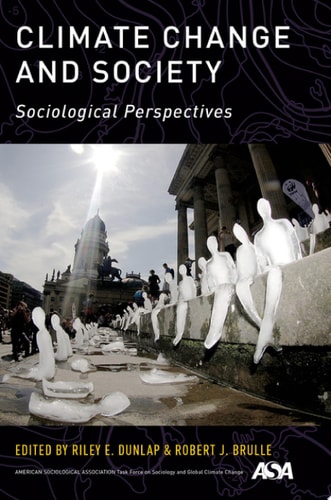
Climate Change and Society: Sociological Perspectives
0
0
As an Amazon Associate and affiliate partner, Menrva Books earns from qualifying purchases. Learn more
Author Description
Climate change is one of the most critical issues of the twenty-first century, presenting a major intellectual challenge to both the natural and social sciences. While there has been significant progress in natural science understanding of climate change, social science analyses have not been as fully developed. Climate Change and Society breaks new theoretical and empirical ground by presenting climate change as a thoroughly social phenomenon, embedded in behaviors, institutions, and cultural practices.This collection of essays summarizes existing approaches to understanding the social, economic, political, and cultural dimensions of climate change. From the factors that drive carbon emissions to those which influence societal responses to climate change, the volume provides a comprehensive overview of the social dimensions of climate change. An improved understanding of the complex relationship between climate change and society is essential for modifying ecologically harmful human behaviors and institutional practices, creating just and effective environmental policies, and developing a more sustainable future. Climate Change and Society provides a useful tool in efforts to integrate social science research, natural science research, and policymaking regarding climate change and sustainability.Produced by the American Sociological Association's Task Force on Sociology and Global Climate Change, this book presents a challenging shift from the standard climate change discourse, and offers a valuable resource for students, scholars, and professionals involved in climate change research and policy.
Menrva's Summary
THE THESIS
This volume investigates how climate change functions as a social phenomenon rather than solely a physical or environmental problem. Edited by Riley E. Dunlap and Robert J. Brulle on behalf of the American Sociological Association's Task Force on Sociology and Global Climate Change, the text synthesizes diverse sociological perspectives to analyze the human behaviors, institutions, and cultural practices that drive carbon emissions and shape societal responses. The authors argue that integrating social science into climate discourse is necessary for developing effective environmental policies and sustainable practices.
THE SCOPE MAP
What You Will Find
- Theoretical frameworks for analyzing climate change as a social construct
- Empirical studies on the drivers of carbon emissions
- Analysis of political and cultural barriers to climate action
- Strategies for integrating social science research with natural science and policymaking
Scope Limits
- The text does not provide primary data on physical climate modeling or meteorological forecasting
- It does not offer a comprehensive guide to individual-level lifestyle changes or personal carbon footprint reduction
THE AUTHORITY PERSPECTIVE
Experts recognize this volume as a foundational text for scholars and policymakers seeking to bridge the gap between natural science and social analysis. Readers frequently note the academic density of the prose, which serves as a rigorous resource for advanced students and professionals in the field.
Page Count:
460
Publication Date:
2015-01-01
Publisher:
Oxford University Press
ISBN-10:
0190269081
ISBN-13:
9780190269081
Social Science
Sociology
Earth Sciences
Climatic changes
Climate Change
Public Policy
Community Tags
Similar Books