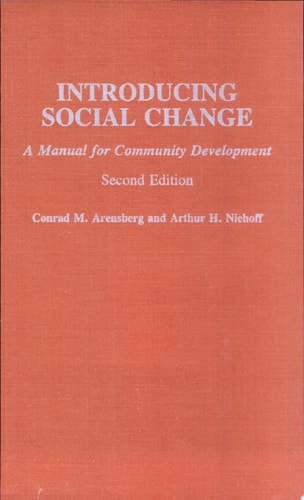
Introducing Social Change: A Manual for Community Development
0
0
As an Amazon Associate and affiliate partner, Menrva Books earns from qualifying purchases. Learn more
Author Description
The development of industry in Europe and the United States has resulted in great marvels of production. However, non-Western nations, with a few exceptions, have not yet shared fully in this productivity, despite the desires of their leaders to do so. Also, in the United States, and in other industrial nations, there are sizeable minority groups which have not been fully assimilated into the productive pattern of the majority. Most live as poverty enclaves within the greater society. This socioeconomic imbalance has contributed to unrest in both the agrarian and industrial nations.Introducing Social Change deals with numerous topics of social change: cultural problems of change in general; a description of the concept of culture; a discussion of cultural change in its various forms; an introduction to the process of directed change; a discussion of the motivation necessary to bring about change; a treatment of the method of adapting an innovation to existing ideas and customs; the profile of the primary characteristics of most developing nations; the main characteristics and cultural values of America as a sample urban, industrial culture; and field problems of the change agent, and in particular those methods from anthropology that can be modified for use.Developments in the industrial countries, particularly the United States, have demonstrated the need for this second edition. When the original version was produced, little thought or activity was given to development efforts among ethnic minorities of industrial countries. Development was thought of almost exclusively as an activity relevant to the developing, non-industrial nations. It has become apparent that ethnic groups in industrial nations are also in need of economic development. Government policies, including funding, have been increasingly pointed in this direction.
Menrva's Summary
THE THESIS
This work investigates the methodologies and cultural complexities involved in implementing directed social change within both developing nations and marginalized communities in industrial societies. The authors, both established anthropologists, utilize their academic expertise to bridge the gap between theoretical cultural studies and practical field application. By examining the friction between traditional customs and modern innovations, the text provides a framework for change agents to navigate socioeconomic imbalances effectively.
THE SCOPE MAP
What You Will Find
- Analysis of cultural change processes and the concept of culture in a global context.
- Strategies for adapting technological and social innovations to existing local customs.
- Profiles of primary characteristics defining developing nations versus industrial urban cultures.
- Practical field methods derived from anthropology for use by community development agents.
THE AUTHORITY PERSPECTIVE
Experts recognize this text as a foundational resource for understanding the intersection of anthropology and applied social development. Readers frequently note the academic density of the prose, which serves as a comprehensive manual for practitioners working in diverse cultural environments.
Page Count:
269
Publication Date:
1971-12-31
Publisher:
Aldine Transaction
ISBN-10:
0202010724
ISBN-13:
9780202010724
Economics
Anthropology
Social change
Community Development
Sociology
Community Tags
Similar Books