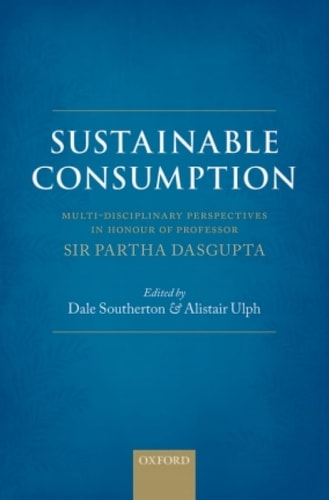
Sustainable Consumption: Multi-disciplinary Perspectives In Honour of Professor Sir Partha Dasgupta
0
0
As an Amazon Associate and affiliate partner, Menrva Books earns from qualifying purchases. Learn more
Author Description
If global society is to address the many environmental and other sustainability challenges that confront us in the twenty-first century, such as climate change and water resources, it will be necessary to make significant changes in our patterns of consumption, production, and distribution. There is a growing realization that while changes in production and distribution are formidable, the proposed solutions may not succeed unless it is possible to persuade individuals and households to change their patterns of consumption to make them more sustainable. However there are significant differences in how key disciplines such as psychology, neuroscience, economics, politics, sociology, anthropology, and history conceptualise consumption, empirically test their theoretical predictions, and use these to inform policy-makers across the private, public and third sectors on how to make consumption more sustainable. This book contains chapters from world-leading experts in these different disciplines that seek to explain the perspectives on sustainable consumption of their disciplines, suggest how these might be further enriched by taking on board some of the findings from other disciplines, and consider what this implies for new policies to address the key sustainability challenges outlined above. The book is dedicated to Professor Sir Partha Dasgupta, one of the world's leading economists who has worked across a range of topics, including environmental and resource economics and development economics, and throughout his career has sought to incorporate into his economic thinking ideas from a range of other disciplines.
Menrva's Summary
THE THESIS
How can multi-disciplinary frameworks be integrated to effectively shift global consumption patterns toward long-term environmental sustainability? The editors, Alistair Ulph and Dale Southerton, compile contributions from leading experts across diverse fields to address the limitations of singular disciplinary approaches. By synthesizing insights from economics, neuroscience, sociology, and history, the text argues that sustainable development requires a cohesive policy strategy that transcends traditional academic silos.
THE SCOPE MAP
What You Will Find
- Comparative analysis of consumption theories across psychology, neuroscience, economics, politics, sociology, and anthropology.
- Policy recommendations for private, public, and third-sector stakeholders.
- Theoretical frameworks for integrating interdisciplinary findings into environmental resource management.
Scope Limits
- The text does not provide a singular, unified theory of consumption but rather a collection of distinct disciplinary perspectives.
- It does not offer a comprehensive manual for individual lifestyle changes, focusing instead on systemic and policy-level interventions.
THE AUTHORITY PERSPECTIVE
Experts recognize this volume as a significant contribution to the field of sustainability studies due to its breadth of disciplinary coverage. Readers frequently note the academic density of the prose, which is intended for researchers and policy-makers seeking to understand the complexities of behavioral change in an environmental context.
Page Count:
320
Publication Date:
2014-01-01
Publisher:
OUP Oxford
ISBN-10:
0191668699
ISBN-13:
9780191668692
Psychology
Economics
Principles of Macroeconomics
Sociology
Public Policy
Sustainability
Anthropology
Consumption Economics
Community Tags
Similar Books