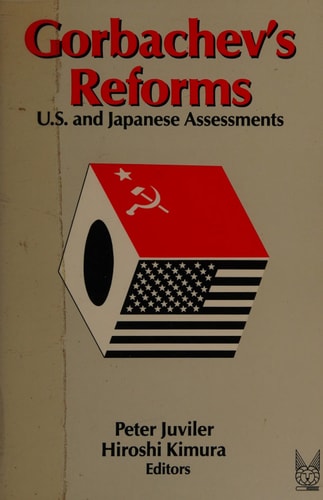
Gorbachev's Reforms: US and Japanese Assessments
0
0
As an Amazon Associate and affiliate partner, Menrva Books earns from qualifying purchases. Learn more
Author Description
Since Mikhail Gorbachev became General Secretary of the Communist Party of the Soviet Union in March 1985, Western analysts have been discussing four main questions—namely, what the party leadership wants to do, what it can do, what it will do, and what the outcome of its decisions will be in practice.
Menrva's Summary
THE THESIS
This volume investigates how American and Japanese analysts interpreted the intent, capacity, and potential outcomes of Mikhail Gorbachev’s reform agenda during the late Soviet era. Peter Juviler and Hiroshi Kimura, both established scholars in political science and international studies, synthesize diverse perspectives to evaluate the geopolitical implications of perestroika and glasnost. The text examines the strategic calculations of the Soviet leadership against the backdrop of evolving foreign policy expectations from the United States and Japan. By comparing these two distinct national viewpoints, the authors provide a framework for understanding the complexities of Soviet reform and its impact on global stability.
THE SCOPE MAP
What You Will Find
- Comparative analysis of US and Japanese foreign policy assessments regarding the USSR.
- Examination of the four core questions surrounding Gorbachev’s leadership: intent, capability, implementation, and practical outcomes.
- Evaluation of the socio-political climate within the Soviet Union from 1985 onward.
- Scholarly synthesis of international relations theory applied to Cold War era transitions.
THE AUTHORITY PERSPECTIVE
Experts recognize this work as a significant contribution to the study of late-Soviet foreign policy and international perception. Readers frequently note the academic density of the prose, which serves as a valuable resource for researchers interested in the comparative history of the Cold War.
Page Count:
178
Publication Date:
1988-12-31
Publisher:
Aldine Transaction
ISBN-10:
0202241688
ISBN-13:
9780202241685
History
Cold War
Soviet Union
International relations
Community Tags
Similar Books