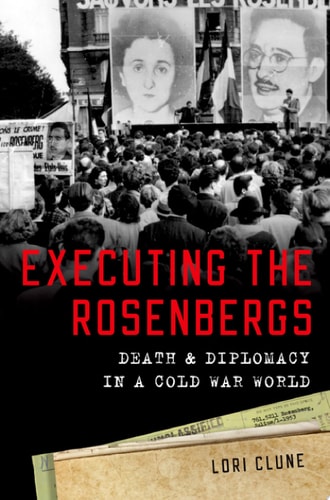
Executing the Rosenbergs
0
0
As an Amazon Associate and affiliate partner, Menrva Books earns from qualifying purchases. Learn more
Author Description
In 1950, Julius and Ethel Rosenberg were arrested for allegedly passing information about the atomic bomb to the Soviet Union, an affair FBI director J. Edgar Hoover labeled the crime of the century. Their case became an international sensation, inspiring petitions, letters of support, newspaper editorials, and protests in countries around the world. Nevertheless, the Rosenbergs were executed after years of appeals, making them the only civilians ever put to death for conspiracy-related activities. Yet even after their executions, protests continued. The Rosenberg case quickly transformed into legend, while the media spotlight shifted to their two orphaned sons. In Executing the Rosenbergs, Lori Clune demonstrates that the Rosenberg case played a pivotal role in the world's perception of the United States. Based on newly discovered documents from the State Department, Clune narrates the widespread dissent against the Rosenberg decision in 80 cities and 48 countries. Even as the Truman and Eisenhower administrations attempted to turn the case into pro-democracy propaganda, U.S. allies and potential allies questioned whether the United States had the moral authority to win the Cold War. Meanwhile, the death of Stalin in 1953 also raised the stakes of the executions; without a clear hero and villain, the struggle between democracy and communism shifted into morally ambiguous terrain. Transcending questions of guilt or innocence, Clune weaves the case -and its aftermath -into the fabric of the Cold War, revealing its far-reaching global effects. An original approach to one of the most fascinating episodes in Cold War history, Executing the Rosenbergs broadens a quintessentially American story into a global one.
Menrva's Summary
THE THESIS
How did the execution of Julius and Ethel Rosenberg shape the global perception of American moral authority during the early Cold War? Lori Clune, a historian specializing in Cold War diplomacy, utilizes newly declassified State Department documents to analyze the international reaction to the Rosenberg trial. She argues that the case served as a critical flashpoint that challenged the United States' ability to frame the Cold War as a clear-cut struggle between democracy and communism. By examining the widespread dissent across 80 cities and 48 countries, Clune demonstrates that the executions undermined U.S. soft power and complicated the narrative of American justice on the global stage.
THE SCOPE MAP
What You Will Find
- Analysis of international protest movements in 48 countries following the Rosenberg trial.
- Examination of State Department records regarding the Truman and Eisenhower administrations' propaganda efforts.
- Investigation into the impact of Stalin's death on the moral framing of the case.
- Contextualization of the Rosenberg case within broader Cold War diplomatic history.
Scope Limits
- The book does not focus on the technical details of the espionage charges or the specific evidence of guilt or innocence.
- It does not provide a comprehensive biography of the Rosenbergs' personal lives outside of the context of the trial and its aftermath.
THE AUTHORITY PERSPECTIVE
Historians and scholars of the Cold War era recognize this work for its shift away from domestic legal debates toward a global diplomatic perspective. Readers frequently note that the text provides a rigorous, research-heavy account that successfully recontextualizes a well-known American event as a significant international incident.
Page Count:
320
Publication Date:
2016-01-01
Publisher:
Oxford University Press
ISBN-10:
0190265892
ISBN-13:
9780190265892
History
Biography
International relations
American History
Cold War
Community Tags
Similar Books