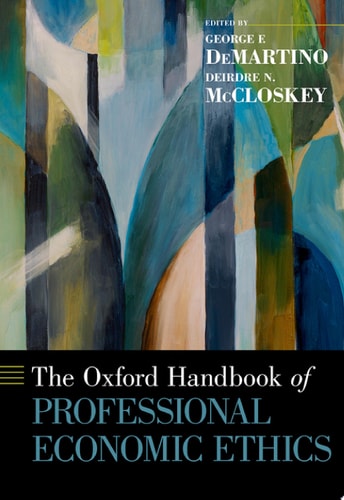
The Oxford Handbook of Professional Economic Ethics
0
0
As an Amazon Associate and affiliate partner, Menrva Books earns from qualifying purchases. Learn more
Author Description
For over a century the economics profession has extended its reach to encompass policy formation and institutional design while largely ignoring the ethical challenges that attend the profession's influence over the lives of others. Economists have proven to be disinterested in ethics. Embracing emotivism, they often treat ethics a matter of mere preference. Moreover, economists tend to be hostile to professional economic ethics, which they incorrectly equate with a code of conduct that would be at best ineffectual and at worst disruptive to good economic practice. But good ethical reasoning is not reducible to mere tastes, and professional ethics is not reducible to a code. Instead, professional economic ethics refers to a new field of investigation-a tradition of sustained and lively inquiry into the irrepressible ethical entailments of academic and applied economic practice.The Oxford Handbook of Professional Economic Ethics explores a wide range of questions related to the nature of ethical economic practice and the content of professional economic ethics. It explores current thinking that has emerged in these areas while widening substantially the terrain of economic ethics. There has never been a volume that poses so directly and intensively the question of the need for and content of professional ethics for economics. The Handbook incorporates the work of leading scholars and practitioners, including academic economists from various theoretical traditions; applied economists, beyond academia, whose work has direct and immense social impact; and philosophers, professional ethicists, and others whose work has addressed the nature of "professionalism" and its implications for ethical practice.
Menrva's Summary
THE THESIS
This volume investigates the necessity and content of professional ethics within the field of economics, challenging the profession's historical tendency to dismiss ethical inquiry as mere subjective preference. Editors Deirdre N. McCloskey and George F. DeMartino assemble a diverse group of academic economists, applied practitioners, and philosophers to argue that economic practice carries inherent ethical entailments. The text seeks to establish a rigorous tradition of inquiry into how economic influence impacts institutional design and individual lives, moving beyond the misconception that professional ethics is limited to a simple code of conduct.
THE SCOPE MAP
What You Will Find
- Theoretical frameworks for ethical economic practice
- Analysis of the intersection between academic economics and public policy
- Perspectives from philosophers and professional ethicists on the nature of professionalism
- Case studies and inquiries into applied economic practice beyond academia
Scope Limits
- Does not provide a singular, prescriptive code of conduct for economists
- Does not focus on historical economic theory independent of its ethical implications
THE AUTHORITY PERSPECTIVE
Experts identify this volume as a foundational text for establishing professional ethics as a legitimate and necessary field of study within economics. Readers frequently note the academic density of the prose, which serves as a comprehensive reference for scholars and practitioners interested in the moral dimensions of economic influence.
Page Count:
799
Publication Date:
2016-01-01
Publisher:
Oxford University Press
ISBN-10:
0190269979
ISBN-13:
9780190269975
Economics
Philosophy
Business Ethics
Public Policy
Professional Ethics
Macroeconomic Theory
Economics
Academic
Community Tags
Similar Books