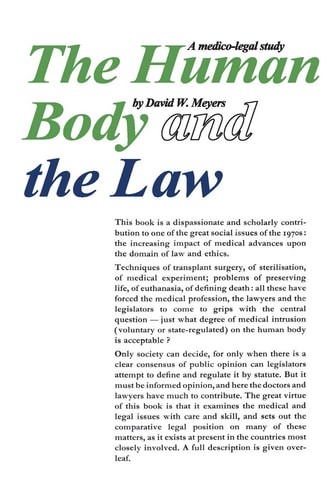
The Human Body and the Law: A Medico-legal Study
0
0
As an Amazon Associate and affiliate partner, Menrva Books earns from qualifying purchases. Learn more
Author Description
In this admirably objective and lucid exposition, the author examines from a medico-legal standpoint the comparative position in various countries, particularly in the UK and the USA, of currently controversial medical procedures: voluntary sterilisation, compulsory sterilisation and castration, trans-sexualism, experimentation, transplantation, and euthanasia - few of which, if any, enjoy a settled or clearly defined place in the eyes of the law. He considers the problems from two perspectives: first, that of the individual in society and how far he himself may determine the extent of physical intrusion on his body; secondly, that of the state or society and how far it may impose or limit medical intrusion on the human body. Thus, Mr. Meyers provides a valuable account, not only of current medical attitudes, but also of relevant case and statute law as it stands at present.It is inherent in the nature of this book that it should arouse controversy and argument. There are many important questions to be debated: Has the state the right to enforce its conception of morality without showing that the behaviour it proscribes has a harmful effect on other members of society? To what extent does consent by the individual concerned insulate a surgeon from criminal liability? In connection with compulsory sterilisation, who is to judge those unfit to procreate? What is a proper definition of medical experimentation? What constitutes death? If a man has a right to live has he not an equal right to die?These are a few of the issues raised. The author has not hesitated to express his own opinions but has clearly relegated them to the summary at the end of each chapter, thereby leaving the objectivity of his main text unimpaired.David W. Meyers is a practicing lawyer in California, with American and British legal qualifications at the firm of Dickenson, Peatman & Fogarty. He has taught at the University of Edinburgh Law School and the University of Tasmania Law School as well as
Menrva's Summary
THE THESIS
This study investigates the complex intersection of medical practice and legal regulation, specifically questioning the extent to which individuals and the state possess authority over physical bodily integrity. David W. Meyers, a lawyer with dual American and British qualifications, utilizes a comparative legal framework to analyze how different jurisdictions address controversial medical procedures. By examining case law and statutes, the author explores the tension between personal autonomy and state-mandated moral or public health objectives.
THE SCOPE MAP
What You Will Find
- Comparative legal analysis of medical procedures in the UK and the USA.
- Examination of controversial topics including voluntary and compulsory sterilization, castration, trans-sexualism, medical experimentation, organ transplantation, and euthanasia.
- Evaluation of the legal limits of individual consent versus state-imposed medical intrusion.
- Synthesis of current medical attitudes and relevant statutory frameworks.
THE AUTHORITY PERSPECTIVE
Experts and legal scholars recognize this work as a foundational comparative study on the legal status of bodily autonomy. Readers frequently note the clarity of the author's objective approach, which effectively separates legal analysis from personal opinion in each chapter.
Page Count:
216
Publication Date:
2006-07-15
Publisher:
Routledge
ISBN-10:
0202308774
ISBN-13:
9780202308777
Non-Fiction
Medical Ethics
Human Body
Ethics
Sociology
Medicine
Law
Community Tags
Similar Books