State of the Masses: Sources of Discontent, Change and Stability
0
0
As an Amazon Associate and affiliate partner, Menrva Books earns from qualifying purchases. Learn more
Author Description
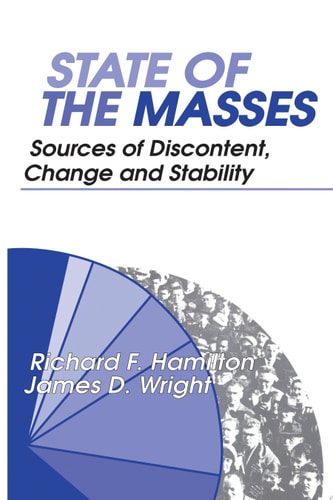
Is the consciousness of Americans in the midst of dramatic transformation? Or do people think and feel much the same as they have always thought and felt? Do most people enjoy their work, or hate it? Is the American family being replaced by new institutional forms, or is it much the same as it was in the 1950's? Have material values been replaced by a "postmaterial consciousness" in a postindustrial society? Are Americans becoming more conservative, less conservative, or staying about the same? State of the Masses asks the important questions.Originally published in 1986, this prescient study evaluate the views of social critics, neo-conservatives, neo-Marxists, post-industrialists, and the theorists of the little man, who puport to describe the nature, social conditions, outlooks, and motivations of the American populace. The claims of one group are often diametrically opposed to those of another. The authors make the case for which claims can be considered true and which false. Hamilton and Wright analyze the contradictory claims and compares their implications with the best social science research and data available at that time. They also explore the implications for theories in light of the conflicting portrait the evidence provides. The authors conclude with a new perspective for understanding continuities and changes in the United States. This is a prescient view of American society during turmoil, and a model for how social science research can be used predictively.
Menrva's Summary
THE THESIS
This work investigates whether the American consciousness underwent a fundamental transformation during the late 20th century or if societal values remained largely consistent despite claims of radical change. Authors James D. Wright and Richard F. Hamilton, both established sociologists, utilize a rigorous comparative framework to evaluate the competing theories of neo-conservatives, neo-Marxists, and post-industrialists. By contrasting these theoretical claims against empirical social science data from the 1980s, the authors identify which sociological assertions hold factual weight and which are unsupported by the evidence. The text serves as a critical examination of how social theory often diverges from the lived reality of the American populace.
THE SCOPE MAP
What You Will Find
- Comparative analysis of competing social theories regarding American work, family, and political values.
- Empirical evaluation of the post-industrial society hypothesis and the concept of postmaterial consciousness.
- Systematic review of social science data to verify or debunk claims made by prominent social critics.
- A methodological framework for using social science research to assess societal stability versus change.
THE AUTHORITY PERSPECTIVE
Experts in the field recognize this text as a rigorous application of empirical methodology to the often speculative realm of social criticism. Readers frequently note the academic density of the prose, which serves as a foundational reference for understanding the intersection of mass politics and sociological theory during the 1980s.
Page Count:
482
Publication Date:
1986-12-31
Publisher:
Aldine Transaction
ISBN-10:
0202303241
ISBN-13:
9780202303246
Public opinion
American History
Sociology
Social Science
Community Tags
Similar Books