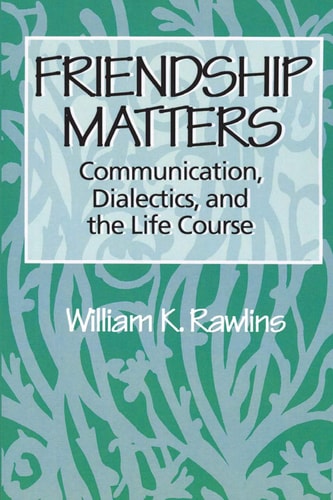
Friendship Matters: Communication, Dialectics, and the Life Course
0
0
As an Amazon Associate and affiliate partner, Menrva Books earns from qualifying purchases. Learn more
Author Description
In this volume, William K. Rawlins traces and investigates the varieties, tensions, and functions of friendship for males and females throughout the life course: how they are managed communicatively, and how they influence and reflect their participants' continually evolving senses of self, relationships, and community. He argues that friendship inherently involves certain dialectical tensions within the larger culture, between friends, and within and across the stages of the life cycle. He also examines notions and meanings of friendship: ethical, civic, romantic, utilitarian, and mundane.
Menrva's Summary
THE THESIS
This volume investigates how friendship functions as a complex communicative practice that shapes individual identity and social order across the human life course. William K. Rawlins, a scholar in communication studies, utilizes a dialectical framework to analyze the inherent tensions within friendships. He argues that these relationships are not static but are actively negotiated through communication, reflecting both personal development and broader cultural expectations. By examining various dimensions of friendship—including ethical, civic, and utilitarian aspects—the author provides a comprehensive model for understanding how these bonds evolve from childhood through adulthood.
THE SCOPE MAP
What You Will Find
- A dialectical framework for analyzing interpersonal communication and relationship maintenance.
- Comparative analysis of friendship dynamics across different stages of the life cycle.
- Examination of the intersection between personal identity, community, and social roles.
- Categorization of friendship types including ethical, romantic, and mundane interactions.
THE AUTHORITY PERSPECTIVE
Scholars in the field of communication studies frequently cite this work as a foundational text for understanding the relational dialectics of friendship. Experts note the academic rigor of the prose, which provides a structured approach to analyzing the communicative complexities of human connection.
Page Count:
320
Publication Date:
1992-01-01
Publisher:
Aldine Transaction
ISBN-10:
0202304043
ISBN-13:
9780202304045
Psychology
Social Science
Sociology
Communication
Interpersonal Relationships
Community Tags
Similar Books