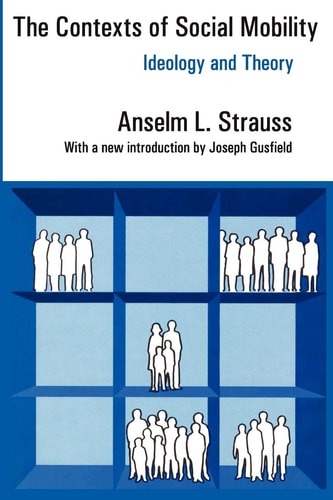
The Contexts of Social Mobility: Ideology and Theory
0
0
As an Amazon Associate and affiliate partner, Menrva Books earns from qualifying purchases. Learn more
Author Description
This book contains a major statement by one of America's most preeminent sociologists on what remains an important problem in American history and social analysis: the nature and extent of movement within American society from one status to another. The most important images of mobility involve self-improvement by changing location (going to the frontier, coming to the big city), and by changing social class (second-generation immigrants). Almost all sociological and historical analysis has been limited to these themes.Strauss extends the concept to a wide range of ideologies, institutional contexts, and social movements; his analysis is based on a formal theory of status passage and develops a partial theory of mobility. Strauss addresses a theme that underscores much of one strand of his work: the changing articulation of individuals with their social structure and institutions.The book follows on from the theoretical presuppositions of Discovery of Grounded Theory and the formal theory presented in Status Passage. Strauss was continually concerned with American social and intellectual life in its historical and contemporary manifestations. No one else has looked at the important phenomenon of mobility in this broad a context and from this point of view. The book remains important to those concerned with the social history of America and with problems of social change.
Menrva's Summary
THE THESIS
This work investigates the multifaceted nature of social mobility in America by challenging traditional, limited definitions of status change. Anselm L. Strauss, a prominent sociologist, utilizes his established theoretical framework of status passage to examine how ideologies and institutional contexts shape individual movement within the social hierarchy. By moving beyond the conventional focus on geographic relocation and class transition, Strauss provides a comprehensive analysis of how individuals articulate their lives within evolving social structures.
THE SCOPE MAP
What You Will Find
- A formal theory of status passage applied to American social history.
- Analysis of diverse ideological frameworks influencing social movement.
- Examination of institutional contexts and their role in individual status change.
- Theoretical connections to the author's previous work on grounded theory and status passage.
THE AUTHORITY PERSPECTIVE
Experts recognize this text as a significant contribution to the study of American social stratification and intellectual history. Scholars frequently note that the book provides a necessary expansion of mobility theory, making it a foundational resource for those analyzing social change and institutional dynamics.
Page Count:
282
Publication Date:
2005-11-15
Publisher:
Routledge
ISBN-10:
0202307735
ISBN-13:
9780202307732
Sociology
United States
Social History
Social Theory
American History