Author Description
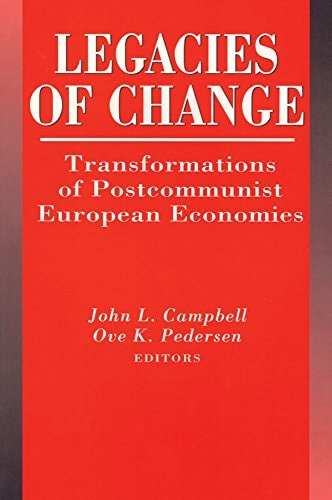
The essays in this volume examine institutional change in five of the most important areas of economic life in central and eastern Europe after 1989: international and regional economic reintegration; the restructuring of the industrial base; how economic interests are to be represented; fiscal and budgetary reform; and reform of the social welfare system. The editors use these research findings to buttress a somewhat heterodox theory of institutional dynamics, one pointing to "discursive structures" and "governance structures" as key dimensions that, in combination, affect institutional change in this part of the world so that an economic "revolution" becomes an evolutionary processes of gradual transition.
Menrva's Summary
THE THESIS
This volume investigates the mechanisms of institutional transformation within post-communist European economies following the collapse of the Soviet bloc in 1989. John L. Campbell and his contributors utilize a heterodox theoretical framework to analyze how discursive and governance structures influence the pace and nature of economic reform. By examining specific sectors, the authors argue that the anticipated rapid economic revolution in Central and Eastern Europe functioned instead as a complex, evolutionary process of gradual transition.
THE SCOPE MAP
What You Will Find
- Analysis of five critical economic domains: international reintegration, industrial restructuring, interest representation, fiscal reform, and social welfare systems.
- A theoretical model focusing on the interplay between discursive structures and governance structures.
- Comparative research findings from multiple Central and Eastern European nations.
- Evaluation of the transition from command economies to market-oriented systems.
THE AUTHORITY PERSPECTIVE
Scholars in the fields of political economy and sociology frequently cite this work for its nuanced approach to institutional change. Experts highlight the text as a valuable resource for understanding the structural complexities that hindered rapid economic liberalization in the post-1989 era.
Page Count:
270
Publication Date:
1996-10-29
Publisher:
De Gruyter
ISBN-10:
0202305589
ISBN-13:
9780202305585
Economics
Sociology
European History
Community Tags
Similar Books