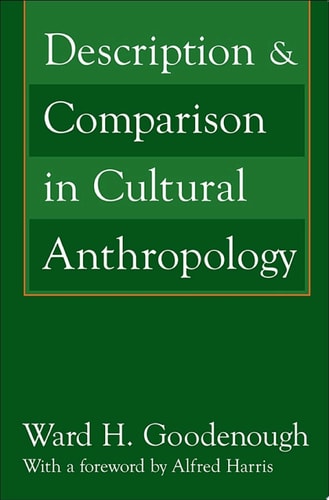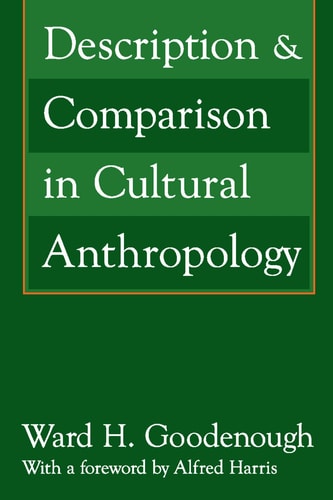
Description and Comparison in Cultural Anthropology
0
0
As an Amazon Associate and affiliate partner, Menrva Books earns from qualifying purchases. Learn more
Author Description
The Lewis Henry Morgan Lectures are intended to commemorate both the man and his work the latter being viewed as having provided an admirably broad and substantial base for anthropologists of later generations to build upon, as they have done and continue to do in diverse ways.Professor Goodenough's work, in the past and in this book particularly, emphasizes the vitality and fruitfulness of Morgan's contributions. Not only do these lectures carry forward Morgan's interests in kinship; they reflect as well his concern for comparative studies undertaken with the aim of ultimately understanding mankind. Moreover, Professor Goodenough has elucidated recent developments in the collection, analysis, and presentation of cultural data in ways that make it easier for all of us to see how his methods (in themselves specialized) can broaden and deepen our understanding of culture and of man.Morgan, himself a pioneer in method, would surely have been an attentive auditor-and discussant-at Professor Goodenough's Lectures, and in his seminars and the less formal events in which he participated while at Rochester, and to which he contributed so much. This volume is an expanded version of the Lewis Henry Morgan Lectures delivered at the University of Rochester, April 2 to 11, 1968.Alfred Harris was a professor emeritus of anthropology at the University of Rochester. He served as the chair of the anthropology from 1964-1971 and he was well known for being the editor of the Lewis Henry Morgan Lectures.
Menrva's Summary
THE THESIS
This volume investigates the evolution of ethnographic description and the utility of comparative analysis within the field of cultural anthropology. The author, Alfred Harris, drawing upon the academic tradition of the Lewis Henry Morgan Lectures, examines how specialized methodologies for collecting and analyzing cultural data can be refined to better understand human social structures. By synthesizing historical anthropological frameworks with contemporary analytical techniques, the text argues for a more rigorous approach to the presentation of ethnographic findings.
THE SCOPE MAP
What You Will Find
- Historical analysis of Lewis Henry Morgan’s contributions to kinship studies.
- Methodological frameworks for the collection and presentation of cultural data.
- Comparative study techniques aimed at broader cross-cultural understanding.
- Academic discourse on the development of anthropological research practices.
THE AUTHORITY PERSPECTIVE
Experts recognize this volume as a significant contribution to the history of anthropological thought, particularly regarding the formalization of ethnographic methods. Readers frequently note the academic density of the prose, which serves as a foundational reference for students and scholars interested in the evolution of social science research.
Page Count:
173
Publication Date:
2006-11-15
Publisher:
Routledge
ISBN-10:
0202308618
ISBN-13:
9780202308616
Ethnology
Social Science
Academic
Methodology
Anthropology