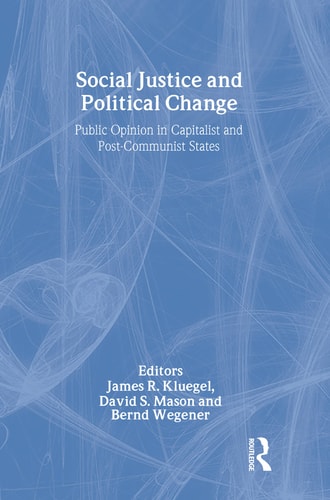
Social Justice and Political Change: Public Opinion in Capitalist and Post-communist States (Social Problems and Social Issues (Walter Hardcover))
0
0
As an Amazon Associate and affiliate partner, Menrva Books earns from qualifying purchases. Learn more
Author Description
Analysis and debate about economic and political justice rarely involves research on the views of the common person. Scholars often make assumptions about what common people think is fair, but for the most part they confine their thinking to a single country and argue on rational or moral grounds, with little supporting empirical data. Social Justice and Political Change, involves the collaboration of thirty social scientists in twelve countries, and represents broad-ranging comparative research. The book grows out of a collaborative study of public opinion about social justice. Though conceived prior to the revolutions that swept Central and Eastern Europe in 1989, the ISJP did not put its survey into the field until the summer of 1991, in a new climate of open international exchange in social research. Employing common methods of data collection and, within the limits of translation, identical survey instruments, the ISJP investigated public opinion in seven newly emerging post-Communist countries and five of the world's most influential capitalist democracies, with special sensitivity to divergencies in the newly united Germany. Among the themes addressed by the volume's distinguished contributors are the views and beliefs of citizens in the post-Communist states on the transition to market economies and parliamentary democracy; the role of ideology in legitimating inequality; the structural determination of beliefs about justice; the processes that shape individual level evaluations; and the major implications of public opinion and mass participation in the democratic process.
Menrva's Summary
THE THESIS
This volume investigates the divergence and commonality in public perceptions of social justice across capitalist democracies and post-communist states. David Mason and a team of thirty international social scientists utilize empirical data from the International Social Justice Project (ISJP) to challenge theoretical assumptions about fairness. By applying identical survey instruments across twelve countries, the contributors examine how political and economic transitions influence individual beliefs regarding inequality and democratic legitimacy.
THE SCOPE MAP
What You Will Find
- Comparative analysis of public opinion in seven post-communist nations and five capitalist democracies.
- Empirical data derived from the International Social Justice Project survey conducted in 1991.
- Examination of the role of ideology in legitimating economic and social inequality.
- Analysis of the structural determinants of justice beliefs during periods of systemic political transition.
THE AUTHORITY PERSPECTIVE
Experts recognize this work as a foundational comparative study that provides rare empirical grounding for theories of social justice. Readers frequently note the academic density of the prose and the rigorous methodological approach taken by the contributors to ensure cross-national data comparability.
Page Count:
359
Publication Date:
1995-12-31
Publisher:
Routledge
ISBN-10:
0202305031
ISBN-13:
9780202305035
Economics
Sociology
Comparative Politics
Public opinion
Social justice