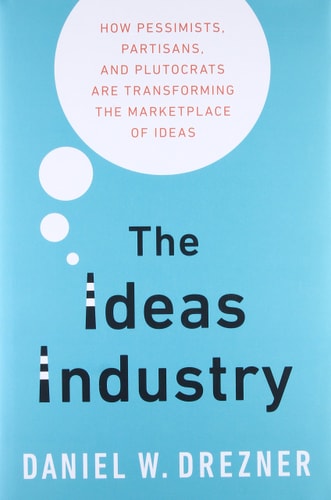
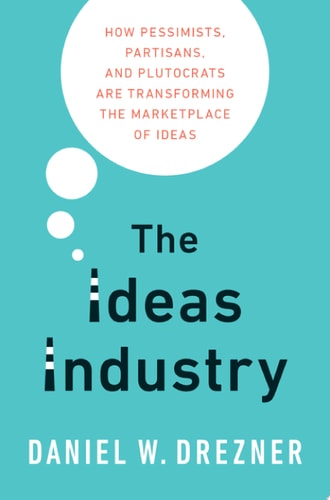
The Ideas Industry: How Pessimists, Partisans, and Plutocrats are Transforming the Marketplace of Ideas
0
0
As an Amazon Associate and affiliate partner, Menrva Books earns from qualifying purchases. Learn more
Author Description
The public intellectual, as a person and ideal, has a long and storied history. Writing in venues like the New Republic and Commentary, such intellectuals were always expected to opine on a broad array of topics, from foreign policy to literature to economics. Yet in recent years a new kind of thinker has supplanted that archetype: the thought leader. Equipped with one big idea, thought leaders focus their energies on TED talks rather than highbrow periodicals.How did this shift happen? In The Ideas Industry, Daniel W. Drezner points to the roles of political polarization, heightened inequality, and eroding trust in authority as ushering in the change. In contrast to public intellectuals, thought leaders gain fame as single-idea merchants. Their ideas are often laudable and highly ambitious: ending global poverty by 2025, for example. But instead of a class composed of university professors and freelance intellectuals debating in highbrow magazines, thought leaders often work through institutions that are closed to the public. They are more immune to criticism--and in this century, the criticism of public intellectuals also counts for less.Three equally important factors that have reshaped the world of ideas have been waning trust in expertise, increasing political polarization and plutocracy. The erosion of trust has lowered the barriers to entry in the marketplace of ideas. Thought leaders don't need doctorates or fellowships to advance their arguments. Polarization is hardly a new phenomenon in the world of ideas, but in contrast to their predecessors, today's intellectuals are more likely to enjoy the support of ideologically friendly private funders and be housed in ideologically-driven think tanks. Increasing inequality as a key driver of this shift: more than ever before, contemporary plutocrats fund intellectuals and idea factories that generate arguments that align with their own. But, while there are certainly some downsides to the contemporary ideas indus
Menrva's Summary
THE THESIS
This book investigates how the transition from the traditional public intellectual to the modern 'thought leader' has fundamentally altered the quality and integrity of public discourse. Daniel W. Drezner, a professor of international politics, utilizes a framework of political economy to analyze the shifting incentives within the marketplace of ideas. He argues that rising inequality, political polarization, and a decline in institutional trust have created a system that favors simplistic, branded concepts over rigorous, evidence-based debate.
THE SCOPE MAP
What You Will Find
- Analysis of the rise of TED-style 'thought leadership' versus traditional academic discourse.
- Examination of the influence of private funding and think tanks on intellectual output.
- Discussion of the impact of economic inequality on the production of policy-relevant ideas.
Scope Limits
- The text does not provide a comprehensive history of all intellectual movements prior to the 20th century.
- It does not offer a prescriptive manual for reversing these trends, focusing instead on descriptive analysis.
THE AUTHORITY PERSPECTIVE
Experts frequently cite this work as a critical contribution to the study of contemporary media and political influence. Readers often note the analytical rigor of Drezner's prose, which provides a clear-eyed assessment of how financial incentives shape the modern intellectual landscape.
Page Count:
360
Publication Date:
2017-04-03
Publisher:
Oxford University Press
ISBN-10:
0190264608
ISBN-13:
9780190264604
Economics
Non-Fiction
Intellectuals
Media Studies
Intellectual History
Learning and scholarship
Sociology
Community Tags
Other Editions(3)
Similar Books






Reader Comments
Share Your Thoughts
No comments yet. Be the first to share your thoughts!