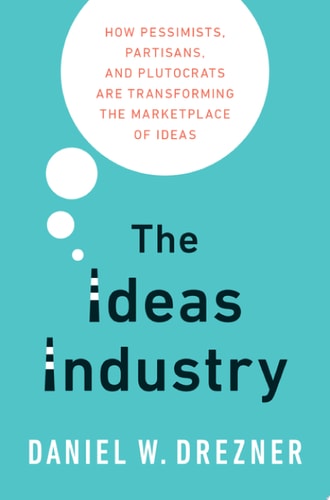
The Ideas Industry: How Pessimists, Partisans, and Plutocrats are Transforming the Marketplace of Ideas
0
0
As an Amazon Associate and affiliate partner, Menrva Books earns from qualifying purchases. Learn more
Author Description
The public intellectual has a long and storied history. Previously, the public intellectual was always expected to opine on a broad array of topics, from foreign policy to economics. Yet in recent years a new kind of thinker has supplanted that archetype: the thought leader. Equipped with one big idea, thought leaders focus their energies on TED talks rather than highbrow periodicals. In contrast to public intellectuals, thought leaders gain fame as single-idea merchants. Their ideas are often laudable and highly ambitious, but they often work through institutions that are closed to the public and less open to criticism. In The Ideas Industry, Daniel W. Drezner explains how this shift happened, pointing to the roles of political polarization, heightened inequality, and eroding trust in authority. In contrast to their predecessors, today's intellectuals are more likely to enjoy the support of ideologically friendly private funders and be housed in ideologically-driven think tanks. Increasing inequality is also a key driver of this shift: more than ever before, contemporary plutocrats fund intellectuals and idea factories that generate arguments that align with their own. Finally, the erosion of trust in experts has lowered the barriers of entry in the marketplace of ideas. But, while there are certainly some downsides to the contemporary ideas industry, Drezner argues that it is very good at broadcasting ideas widely and reaching large audiences hungry for new thinking. Both fair-minded and trenchant, The Ideas Industry reshapes our understanding of contemporary public intellectual life in America and the West.
Menrva's Summary
THE THESIS
This book investigates how the transition from the traditional public intellectual to the modern 'thought leader' has fundamentally altered the quality and credibility of public discourse. Daniel W. Drezner, a professor of international politics, utilizes a framework of political economy to analyze the shifting incentives within the marketplace of ideas. He argues that rising economic inequality, political polarization, and a decline in institutional trust have incentivized the production of narrow, 'big idea' content over nuanced, broad-spectrum analysis. By examining the funding structures and institutional environments of contemporary think tanks and media platforms, Drezner maps the transformation of intellectual labor in the 21st century.
THE SCOPE MAP
What You Will Find
- Analysis of the 'thought leader' archetype versus the traditional public intellectual.
- Examination of the impact of plutocratic funding on academic and policy research.
- Discussion of the role of political polarization in narrowing the scope of acceptable public debate.
- Evaluation of the influence of digital media and TED-style platforms on idea dissemination.
Scope Limits
- The analysis focuses primarily on the United States and Western intellectual ecosystems.
- The text does not provide a comprehensive history of all intellectual movements, focusing instead on the post-Cold War era.
THE AUTHORITY PERSPECTIVE
Experts and reviewers frequently cite this work as a rigorous, data-informed critique of contemporary media and policy environments. Readers often note the academic density of the prose, which balances sociological observation with accessible political analysis.
Page Count:
356
Publication Date:
2017-01-01
Publisher:
Oxford University Press
ISBN-10:
0190264624
ISBN-13:
9780190264628
Economics
Non-Fiction
Intellectuals
Media Studies
Globalization
Intellectual History
Introduction to Human Communication
Communications
Sociology
American Government
Community Tags
Other Editions(3)

Similar Books











Reader Comments
Share Your Thoughts
No comments yet. Be the first to share your thoughts!