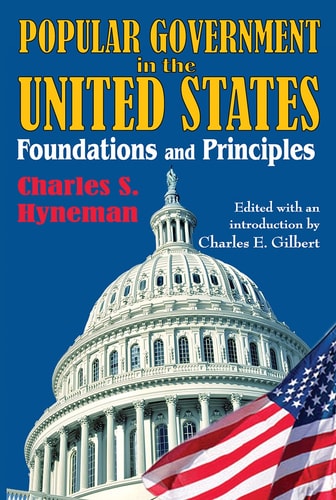
Popular Government in the United States: Foundations and Principles
0
0
As an Amazon Associate and affiliate partner, Menrva Books earns from qualifying purchases. Learn more
Author Description
Political theory consists in clarification of language and concepts, in description and analysis of institutions and behavior, and in appraisal and evaluation of political events. Hyneman's theory is not one of the behavioral or functional varieties that rely on special language and concepts drawn from other disciplines than political science. It emphasizes a central concern of both conventional and behavioral theory: the distribution of "power," or what proportion of people have influence over what aspects of government. He is also interested in how power is shared, divided, checked, and balanced.The main task of political theory, Hyneman thinks, is clarification of the values served by and sustaining American democracy. This task gives meaning and direction to analysis of the elements of democracy and to empirical research on the processes of democracy. In this sense political science is not "value-free"; it is most useful in pursuit of the implications of basic beliefs and ideals. These beliefs and ideals can be found in historical statements as well as inferred from institutions and behavior.Hyneman's emphasis on popular control, electoral politics, and equality of influence tends to challenge both of the "pluralist" and "ruling elite" schools-though it should be clear that he is not engaged in a scholastic debate. The freedom of his analysis, ranging from specific reference to the professional controversies of his day is one of its strengths and a probable source of originality. He connects it explicitly to the literature of political science at critical points, as it existed when originally published in 1968.
Menrva's Summary
THE THESIS
This work investigates the foundational principles and operational realities of popular government within the United States, specifically questioning how power is distributed and maintained in a democracy. Charles S. Hyneman, a noted political scientist, rejects the specialized jargon of behavioralism in favor of a direct examination of political institutions and democratic values. He argues that political science must actively engage with the underlying ideals of a society rather than attempting to remain entirely value-free, using this framework to evaluate the efficacy of American governance.
THE SCOPE MAP
What You Will Find
- Analysis of the distribution of power and influence among the American populace.
- Examination of the mechanisms of checks and balances within the federal system.
- Evaluation of the role of electoral politics in sustaining democratic control.
- Critique of pluralist and ruling elite theories as they existed in the late 1960s.
THE AUTHORITY PERSPECTIVE
Experts recognize this text as a significant contribution to mid-twentieth-century political theory that bridges the gap between empirical research and normative democratic values. Readers often note the clarity of Hyneman's prose, which avoids the dense, discipline-specific jargon common in contemporary behavioral studies.
Page Count:
344
Publication Date:
2010-02-15
Publisher:
Routledge
ISBN-10:
0202363473
ISBN-13:
9780202363479
History
Democracy
United States
American Government
Political Theory
Community Tags
Similar Books