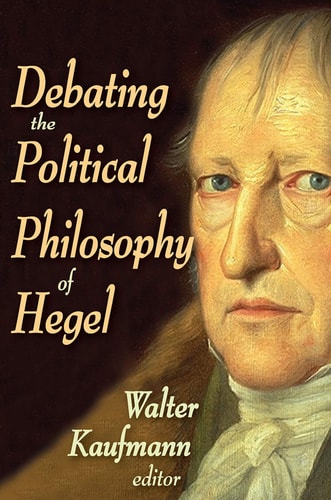
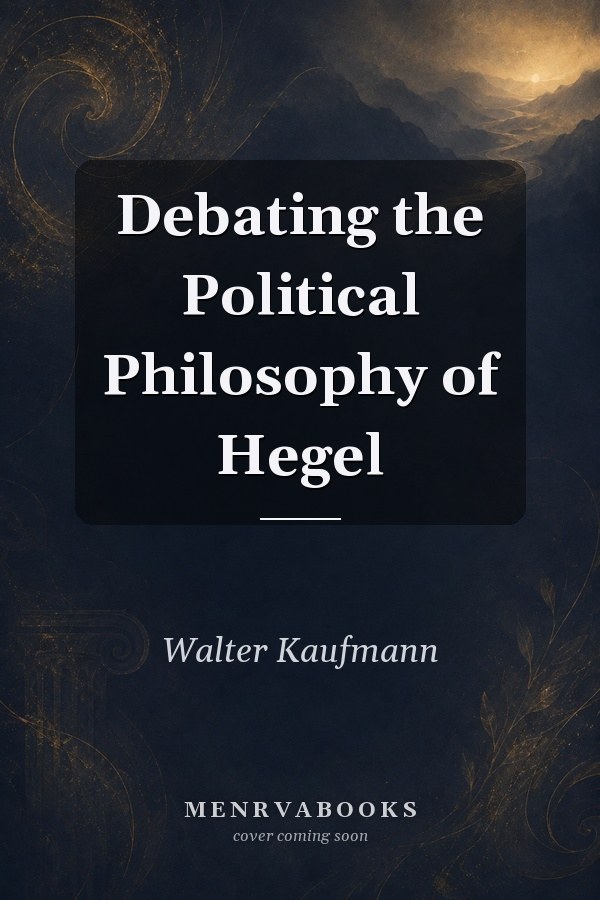
Debating the Political Philosophy of Hegel
0
0
As an Amazon Associate and affiliate partner, Menrva Books earns from qualifying purchases. Learn more
Author Description
Few philosophers have had as much influence as Hegel. When he died in 1831, he not only dominated German philosophy, but also left his mark on the study of religion and art, on historical studies, and on political thought. Much later, Lenin insisted that no one could completely comprehend Karl Marx unless he had first made a thorough study of Hegel. Later, it became fashionable to link Hegel with Nazism and communism. There is today broad agreement that knowledge of Hegel's thought adds a critical dimension to our understanding of recent cultural and political history. This volume, first published in 1970, focuses on Hegel's political philosophy. It brings together ten essays by six authors who present sharply conflicting interpretations. Here are point-by-point discussions, from differing perspectives, on Hegel's philosophy of the state and his ideas about history and war, nationalism and liberty. Never before have these issues been joined in comparable fashion in a single volume. Sidney Hook sees Hegel as "the very model of a small - minded, timid Continental conservative" and accuses him of "the most specious reasoning that ever disgraced a philosopher," and E. F. Carritt argues for a "totalitarian" reading of Hegel, while T. M. Knox and Shlomo Avineri defend Hegel against these and other charges. The book also contains a short contribution by Z. A. Pelczynski and Walter Kaufmann's "The Hegel Myth and Its Method." Walter Kaufmann, an outstanding historian of European ideas in philosophy, furnished an introduction as well as footnotes that help to clarify perplexing issues and in some cases seek to put an end to long-lived errors. His analysis is itself a major contribution to Hegel's political theories.
Menrva's Summary
THE THESIS
This volume investigates the contentious legacy of G.W.F. Hegel’s political philosophy and the validity of the various ideological labels—ranging from conservative to totalitarian—attributed to his work. Walter Kaufmann, a noted historian of European ideas, curates a collection of essays that examine the intersection of Hegel’s thought with concepts of the state, history, war, nationalism, and liberty. By assembling six scholars with divergent viewpoints, the text provides a structured debate designed to clarify historical misconceptions and evaluate the impact of Hegelian theory on modern political discourse.
THE SCOPE MAP
What You Will Find
- A collection of ten essays analyzing Hegel’s political philosophy from six distinct scholarly perspectives.
- Point-by-point debates regarding the alleged links between Hegelian thought and totalitarianism, conservatism, and nationalism.
- Critical analysis of Hegel’s theories on the state, historical progression, and the nature of liberty.
- Editorial footnotes and an introduction by Walter Kaufmann intended to correct long-standing misinterpretations of Hegel’s primary texts.
THE AUTHORITY PERSPECTIVE
Experts recognize this volume as a significant resource for understanding the polarized reception of Hegel’s political ideas in the twentieth century. Readers frequently note the academic density of the prose and the value of the direct, conflicting arguments presented by the contributors.
Page Count:
188
Publication Date:
2010-01-30
Publisher:
Routledge
ISBN-10:
020236349X
ISBN-13:
9780202363493
Non-Fiction
Philosophy
History
Political Philosophy
Philosophy German
Community Tags
Other Editions(3)
Similar Books



Reader Comments
Share Your Thoughts
No comments yet. Be the first to share your thoughts!