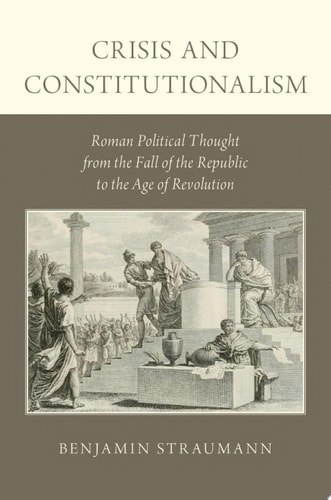
Crisis and Constitutionalism: Roman Political Thought from the Fall of the Republic to the Age of Revolution
0
0
As an Amazon Associate and affiliate partner, Menrva Books earns from qualifying purchases. Learn more
Author Description
Crisis and Constitutionalism argues that the late Roman Republic saw, for the first time in the history of political thought, the development of a normative concept of constitution--the concept of a set of constitutional norms designed to guarantee and achieve certain interests of the individual. Benjamin Straumann first explores how a Roman concept of constitution emerged out of the crisis and fall of the Roman Republic. The increasing use of emergency measures and extraordinary powers in the late Republic provoked Cicero and some of his contemporaries to turn a hitherto implicit, inchoate constitutionalism into explicit constitutional argument and theory. The crisis of the Republic thus brought about a powerful constitutionalism and convinced Cicero to articulate the norms and rights that would provide its substance; this typically Roman constitutional theory is described in the second part of the study. Straumann then discusses the reception of Roman constitutional thought up to the late eighteenth century and the American Founding, which gave rise to a new, constitutional republicanism. This tradition was characterized by a keen interest in the Roman Republic's decline and fall, and an insistence on the limits of virtue. The crisis of the Republic was interpreted as a constitutional crisis, and the only remedy to escape the Republic's fate--military despotism--was thought to lie, not in republican virtue, but in Roman constitutionalism. By tracing Roman constitutional thought from antiquity to the modern era, this unique study makes a substantial contribution to our understanding of Roman political thought and its reception.
Menrva's Summary
THE THESIS
This work investigates how the political crises of the late Roman Republic catalyzed the development of a formal, normative concept of constitutionalism. Benjamin Straumann, a scholar of Roman law and political thought, examines the transition from implicit political norms to explicit constitutional theory. By analyzing the writings of Cicero and his contemporaries, the author argues that the Roman response to emergency powers and systemic instability provided the foundational framework for modern constitutional republicanism.
THE SCOPE MAP
What You Will Find
- Analysis of Roman political theory during the transition from Republic to Empire
- Examination of Ciceronian constitutional arguments regarding individual rights and state norms
- Historical tracing of Roman political thought through the Enlightenment and the American Founding
- Evaluation of the shift from reliance on republican virtue to reliance on constitutional limits
Scope Limits
- The study does not provide a comprehensive history of Roman military or social structures outside of their constitutional implications
- The analysis focuses primarily on Western political reception rather than Eastern or non-Western constitutional traditions
THE AUTHORITY PERSPECTIVE
Scholars and historians recognize this text as a rigorous examination of the intellectual lineage connecting Roman political theory to modern governance. Readers frequently note the academic density of the prose, which requires a foundational understanding of classical history and political philosophy to fully appreciate the author's arguments.
Page Count:
414
Publication Date:
2016-01-01
Publisher:
Oxford University Press
ISBN-10:
0190614005
ISBN-13:
9780190614003
History
Republicanism
Constitutional Law
Ancient History
Rome
Political Philosophy
Constitutional History
Roman History
Professional Career & Trade
Community Tags
Similar Books