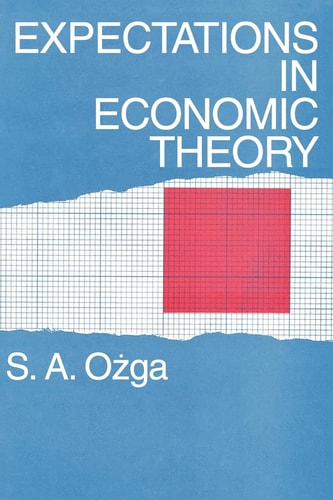
Expectations in Economic Theory
0
0
As an Amazon Associate and affiliate partner, Menrva Books earns from qualifying purchases. Learn more
Author Description
This book deals with economic theory, not methodology. It does employ certain methodological resolutions. These resolutions and the limitations they impose on the nature and the scope of the analysis are reviewed. The first resolution concerns what kind of a theory is to be discussed. The word theory may mean many things; it may mean a hypothesis put forward as an explanation of something, an idea, or a notion. In a normative sense it may mean a recommendation, a rule, or principle to be followed. In science it usually means a system of hypotheses to be accepted as an explanation of certain facts, a set of general laws, and principles. It is also used to distinguish the general principles and methods of a subject from the practice of it.The theory with which this volume is concerned is that of science. In very general terms it may be defined as a system of hypotheses, one following from another, which permits the reader to derive from known facts and predictions of other facts. If the knowledge of the fact which we predict is important for us, in the sense that it permits us to achieve better the objectives we pursue, the theory may have a practical value. This book is therefore not only a contribution to the analysis of expectations but also an introduction to a number of selected topics in economic theory.
Menrva's Summary
THE THESIS
This book investigates the role and function of expectations within the framework of formal economic theory. The author, S. A. Ozga, approaches the subject by defining economic theory as a rigorous system of hypotheses designed to explain facts and facilitate predictions. By distinguishing between normative recommendations and scientific principles, the text establishes a structured methodology for analyzing how expectations influence economic outcomes and practical decision-making.
THE SCOPE MAP
What You Will Find
- A formal definition of economic theory as a system of interconnected hypotheses.
- An analysis of the methodological resolutions required to study expectations.
- A review of the limitations inherent in applying theoretical models to real-world economic facts.
- An introduction to selected topics in economic theory that demonstrate the practical value of predictive modeling.
THE AUTHORITY PERSPECTIVE
Experts recognize this work as a specialized contribution to the study of expectations within the broader field of economic theory. Readers frequently note the academic density of the prose, which is intended for those familiar with formal economic modeling and scientific methodology.
Page Count:
302
Publication Date:
2007-12-15
Publisher:
Routledge
ISBN-10:
0202361551
ISBN-13:
9780202361550
Science
Economics
Economic Theory
Academic
Community Tags
Other Editions(6)



Similar Books














Reader Comments
Share Your Thoughts
No comments yet. Be the first to share your thoughts!