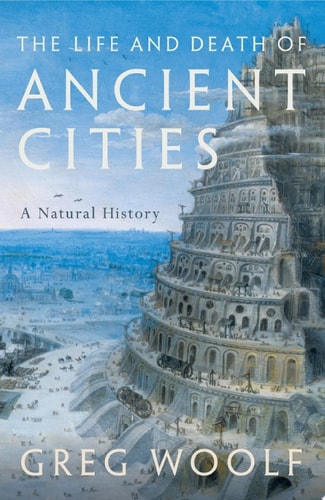
The Life and Death of Ancient Cities: A Natural History
0
0
As an Amazon Associate and affiliate partner, Menrva Books earns from qualifying purchases. Learn more
Author Description
The human race is on a 10,000 year urban adventure. Our ancestors wandered the planet or lived scattered in villages, yet by the end of this century almost all of us will live in cities. But that journey has not been a smooth one and urban civilizations have risen and fallen many times in history. The ruins of many of them still enchant us. This book tells the story of the rise and fall of ancient cities from the end of the Bronze Age to the beginning of the Middle Ages. It is a tale of war and politics, pestilence and famine, triumph and tragedy, by turns both fabulous and squalid. Its focus is on the ancient Mediterranean: Greeks and Romans at the centre, but Phoenicians and Etruscans, Persians, Gauls, and Egyptians all play a part. The story begins with the Greek discovery of much more ancient urban civilizations in Egypt and the Near East, and charts the gradual spread of urbanism to the Atlantic and then the North Sea in the centuries that followed. The ancient Mediterranean, where our story begins, was a harsh environment for urbanism. So how were cities first created, and then sustained for so long, in these apparently unpromising surroundings? How did they feed themselves, where did they find water and building materials, and what did they do with their waste and their dead? Why, in the end, did their rulers give up on them? And what it was like to inhabit urban worlds so unlike our own - cities plunged into darkness every night, cities dominated by the temples of the gods, cities of farmers, cities of slaves, cities of soldiers. Ultimately, the chief characters in the story are the cities themselves. Athens and Sparta, Persepolis and Carthage, Rome and Alexandria: cities that formed great families. Their story encompasses the history of the generations of people who built and inhabited them, whose short lives left behind monuments that have inspired city builders ever since - and whose ruins stand as stark reminders to the 21st century of the perils as well.
Menrva's Summary
THE THESIS
This work investigates the environmental, political, and social mechanisms that allowed ancient Mediterranean cities to emerge, persist, and ultimately collapse over several millennia. Greg Woolf, a historian specializing in the ancient world, utilizes archaeological evidence and historical records to construct a narrative of urban development. He argues that the city is not a static entity but a fragile, evolving organism shaped by its inhabitants' ability to manage resources, waste, and external threats.
THE SCOPE MAP
What You Will Find
- Analysis of urban infrastructure including water supply, waste management, and food logistics.
- Historical examination of major urban centers such as Athens, Rome, Carthage, and Alexandria.
- Exploration of the transition from Bronze Age settlements to the early Middle Ages.
- Discussion of the cultural and religious roles of urban spaces.
Scope Limits
- The analysis is geographically constrained primarily to the Mediterranean basin and its immediate peripheries.
- The text does not provide a comprehensive global history of urbanism outside of the Greco-Roman and Near Eastern spheres.
THE AUTHORITY PERSPECTIVE
Scholars and readers frequently note the accessibility of Woolf's prose despite the depth of his historical synthesis. Experts highlight this as a significant contribution to the study of urban evolution, praising the author's ability to treat the city itself as the primary subject of the narrative.
Page Count:
517
Publication Date:
2020-01-01
Publisher:
OUP Oxford
ISBN-10:
0191641820
ISBN-13:
9780191641824
History
European History
History - Ancient
Sociology
Ancient History
Special Topics
Archaeology
Middle Ages
Rome
World Civilization
Urban Studies
Community Tags
Similar Books