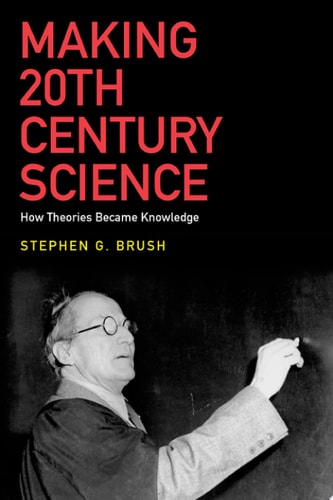
Making 20th Century Science: How Theories Became Knowledge
0
0
As an Amazon Associate and affiliate partner, Menrva Books earns from qualifying purchases. Learn more
Author Description
Historically, the scientific method has been said to require proposing a theory, making a prediction of something not already known, testing the prediction, and giving up the theory (or substantially changing it) if it fails the test. A theory that leads to several successful predictions is more likely to be accepted than one that only explains what is already known but not understood. This process is widely treated as the conventional method of achieving scientific progress, and was used throughout the twentieth century as the standard route to discovery and experimentation.But does science really work this way? In Making 20th Century Science, Stephen G. Brush discusses this question, as it relates to the development of science throughout the last century. Answering this question requires both a philosophically and historically scientific approach, and Brush blends the two in order to take a close look at how scientific methodology has developed. Several cases from the history of modern physical and biological science are examined, including Mendeleev's Periodic Law, Kekule's structure for benzene, the light-quantum hypothesis, quantum mechanics, chromosome theory, and natural selection. In general it is found that theories are accepted for a combination of successful predictions and better explanations of old facts.Making 20th Century Science is a large-scale historical look at the implementation of the scientific method, and how scientific theories come to be accepted.
Menrva's Summary
THE THESIS
This book investigates whether the conventional scientific method—proposing a theory, testing predictions, and discarding failed hypotheses—accurately reflects how scientific knowledge was actually constructed during the twentieth century. Stephen G. Brush, a physicist and historian of science, utilizes a dual-disciplinary approach to analyze the development of modern scientific methodology. By examining the historical record of major breakthroughs, he argues that the acceptance of scientific theories relies on a complex interplay between successful predictive power and the ability to provide superior explanations for established phenomena.
THE SCOPE MAP
What You Will Find
- Historical case studies including Mendeleev's Periodic Law, Kekule's benzene structure, and quantum mechanics.
- Analysis of biological developments such as chromosome theory and natural selection.
- A comparative framework evaluating the role of prediction versus explanation in theory acceptance.
Scope Limits
- The text focuses primarily on physical and biological sciences, excluding detailed analysis of social or behavioral sciences.
- It does not provide a prescriptive guide for modern experimentation, focusing instead on historical and philosophical retrospective.
THE AUTHORITY PERSPECTIVE
Experts recognize this work as a significant contribution to the history and philosophy of science, noting its ability to bridge the gap between technical scientific development and historical methodology. Readers frequently highlight the academic density of the prose, which is well-suited for students and scholars interested in the evolution of scientific thought.
Page Count:
552
Publication Date:
2015-01-01
Publisher:
Oxford University Press
ISBN-10:
0190266945
ISBN-13:
9780190266943
History
Non-Fiction
Philosophy of
Physics
Earth Sciences
Science
Science History
Biology
Community Tags
Similar Books