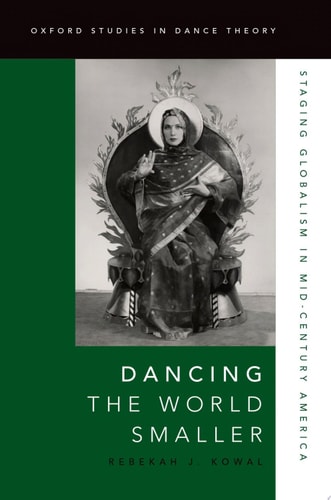
Dancing the World Smaller: Staging Globalism in Mid-Century America
0
0
As an Amazon Associate and affiliate partner, Menrva Books earns from qualifying purchases. Learn more
Author Description
This is an open access title. It is available to read and download as a free PDF on the Oxford Academic platform. It is made available under a CC BY-NC-ND 4.0 International licence. Dancing the World Smaller examines international dance performances in New York City in the 1940s as sites in which dance artists and audiences contested what it meant to practice globalism in mid-twentieth-century America. During and after the Second World War, modern dance and ballet thrived in New York City, a fertile cosmopolitan environment in which dance was celebrated as an emblem of American artistic and cultural dominance. In the ensuing Cold War years, American choreographers and companies were among those the U.S. government sent abroad to serve as ambassadors of American cultural values and to extend the nation's geo-political reach. Less-known is that international dance performance, or what was then-called "ethnic" or "ethnologic" dance, enjoyed strong support among audiences in the city and across the nation as well. Produced in non-traditional dance venues, such as the American Museum of Natural History, the Ethnologic Dance Center, and Carnegie Hall, these performances elevated dance as an intercultural bridge across human differences and dance artists as transcultural interlocutors. Dancing the World Smaller draws on extensive archival resources, as well as critical and historical studies of race and ethnicity in the U.S., to uncover a hidden history of globalism in American dance and to see artists such as La Meri, Ruth St. Denis, Asadata Dafora, Pearl Primus, José Limón, Ram Gopal, and Charles Weidman in new light. Debates about how to practice globalism in dance proxied larger cultural struggles over how to reconcile the nation's new role as a global superpower. In dance as in cultural politics, Americans labored over how to realize diversity while honoring difference and manage dueling impulses toward globalism, on the one hand, and isolationism, on the other.
Menrva's Summary
THE THESIS
This book investigates how international dance performances in 1940s New York City served as a primary site for negotiating the meaning of globalism in mid-twentieth-century America. Rebekah J. Kowal, a scholar of dance theory, utilizes archival research and historical analysis to argue that dance functioned as a proxy for broader geopolitical debates. By examining the work of choreographers and performers who navigated the tension between American cultural dominance and intercultural exchange, the text illustrates how the arts reflected the nation's struggle to define its role as a global superpower.
THE SCOPE MAP
What You Will Find
- Historical analysis of dance performances in New York City during the 1940s and early Cold War era.
- Examination of the intersection between U.S. foreign policy and cultural diplomacy.
- Case studies of influential artists including La Meri, Ruth St. Denis, Asadata Dafora, Pearl Primus, José Limón, Ram Gopal, and Charles Weidman.
- Investigation into non-traditional performance venues such as the American Museum of Natural History and the Ethnologic Dance Center.
Scope Limits
- The study focuses primarily on the New York City dance scene and its specific influence on American perceptions of globalism.
- The text does not provide a comprehensive history of all global dance forms, but rather focuses on those categorized as 'ethnic' or 'ethnologic' within the U.S. context.
THE AUTHORITY PERSPECTIVE
Scholars in the field of dance theory and American cultural history identify this work as a significant contribution to understanding the intersection of performance and geopolitical identity. Readers frequently note the depth of the archival research and the clarity with which the author connects artistic practice to the political climate of the mid-twentieth century.
Page Count:
294
Publication Date:
2019-01-01
Publisher:
Oxford University Press
ISBN-10:
0190265345
ISBN-13:
9780190265342
History
American History
Dance
Cold War
Humanities
globalism
Dance History
United States
Dancers
Community Tags
Similar Books