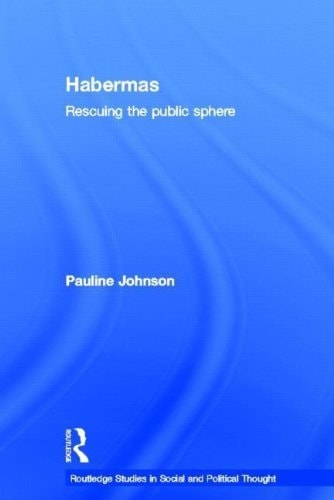
Habermas: Rescuing the Public Sphere
0
0
As an Amazon Associate and affiliate partner, Menrva Books earns from qualifying purchases. Learn more
Author Description
If we are to believe what many sociologists are telling us, the public sphere is in a near terminal state. Our ability to build solidarities with strangers and to agree on the general significance of needs and problems seems to be collapsing. These cultural potentials appear endangered by a newly aggressive attempt to universalize and extend the norms of the market. For four decades Habermas has been trying to bring the claims of a modern public sphere before us. His vast oeuvre has investigated its historical, sociological and theoretical preconditions, has explored its relevance and meaning as well as diagnosing its on-going crises. In the contemporary climate, a systematic look at Habermas’ lifelong project of rescuing the modern public sphere seems an urgent task.This study reconstructs major developments in Habermas’ thinking about the public sphere, and is a contribution to the current vigorous debate over its plight. It marshals the significance of Habermas’ lifetime of work on this topic to illuminate what is at stake in a contemporary interest in rescuing an embattled modern public sphere.Habermas’ project of rescuing the neglected potentials of Enlightenment legacies has been deeply controversial. For many, it is too lacking in radical commitments to warrant its claim to a contemporary place within a critical theory tradition. Against this developing consensus, Pauline Johnson describes Habermas’ project as one that is still informed by utopian energies, even though his own construction of emancipatory hopes itself proves to be too narrow and one-sided.
Menrva's Summary
THE THESIS
Can the modern public sphere be salvaged from the encroaching dominance of market norms, and what role does the work of Jürgen Habermas play in this potential rescue? Pauline Johnson provides a comprehensive reconstruction of Habermas’s intellectual trajectory regarding the public sphere, examining his lifelong commitment to Enlightenment ideals. She evaluates his theoretical framework against contemporary critiques that label his approach as insufficiently radical, ultimately arguing that his work remains vital for understanding modern emancipatory possibilities.
THE SCOPE MAP
What You Will Find
- A systematic reconstruction of Habermas’s historical and sociological theories on the public sphere.
- An analysis of the tension between market-driven norms and democratic solidarity.
- A critical evaluation of the 'Enlightenment legacy' within the tradition of critical theory.
- A synthesis of current academic debates regarding the viability of public discourse in the modern era.
THE AUTHORITY PERSPECTIVE
Scholars and students of critical theory view this text as a rigorous engagement with Habermas’s complex body of work. It is frequently cited for its balanced approach in defending the relevance of Habermasian thought against contemporary detractors.
Page Count:
0
Publication Date:
2005-07-01
Publisher:
Taylor & Francis DUMP LIST
ISBN-10:
0203020162
ISBN-13:
9780203020166
Self-help
Philosophy
Politics
Sociology
Success
Critical Theory
Community Tags
Other Editions(3)
Similar Books