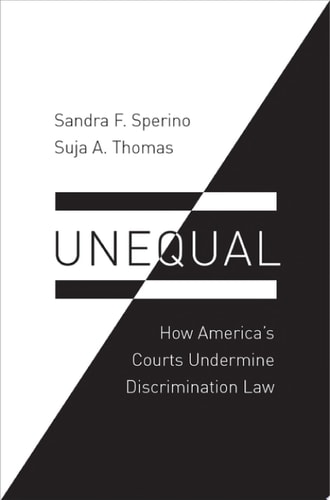
Unequal
0
0
As an Amazon Associate and affiliate partner, Menrva Books earns from qualifying purchases. Learn more
Author Description
It Is No Secret That Since The 1980s, American Workers Have Lost Power Vis-à-vis Employers Through The Well-chronicled Steep Decline In Private Sector Unionization. American Workers Have Also Lost Power In Other Ways. Those Alleging Employment Discrimination Have Fared Increasingly Poorly In The Courts. In Recent Years, Judges Have Dismissed Scores Of Cases In Which Workers Presented Evidence That Supervisors Referred To Them Using Racial Or Gender Slurs. In One Federal District Court, Judges Dismissed More Than 80 Percent Of The Race Discrimination Cases Filed Over A Year. And When Juries Return Verdicts In Favor Of Employees, Judges Often Second Guess Those Verdicts, Finding Ways To Nullify The Jury's Verdict And Rule In Favor Of The Employer. Most Americans Assume That That An Employee Alleging Workplace Discrimination Faces The Same Legal System As Other Litigants. After All, We Do Not Usually Think That Legal Rules Vary Depending Upon The Type Of Claim Brought. The Employment Law Scholars Sandra A. Sperino And Suja A. Thomas Show In Unequal That Our Assumptions Are Wrong. Over The Course Of The Last Half Century, Employment Discrimination Claims Have Come To Operate In A Fundamentally Different Legal System Than Other Claims. It Is In Many Respects A Parallel Universe, One In Which The Legal System Systematically Favors Employers Over Employees. A Host Of Procedural, Evidentiary, And Substantive Mechanisms Serve As Barriers For Employees, Making It Extremely Difficult For Them To Access The Courts. Moreover, These Mechanisms Make It Fairly Easy For Judges To Dismiss A Case Prior To Trial. Americans Are Unaware Of How The System Operates Partly Because They Think That Race And Gender Discrimination Are In The Process Of Fading Away. But Such Discrimination Still Happens In The Workplace, And Workers Now Have Little Recourse To Fight It Legally. By Tracing The Modern History Of Employment Discrimination, Sperino And Thomas Provide An Authoritative Account Of How
Menrva's Summary
THE THESIS
This book investigates the systemic legal barriers that prevent employees from successfully litigating workplace discrimination claims in the United States. Sandra F. Sperino and Suja A. Thomas, both established legal scholars, utilize decades of court data and case law to argue that employment discrimination claims operate within a parallel legal universe that systematically favors employers over employees. They demonstrate how procedural, evidentiary, and substantive mechanisms have been constructed to limit access to justice and undermine jury verdicts.
THE SCOPE MAP
What You Will Find
- Analysis of the decline in successful employment discrimination litigation since the 1980s.
- Examination of judicial practices that lead to the dismissal of cases prior to trial.
- Review of how procedural and evidentiary rules create hurdles for plaintiffs.
- Historical context regarding the evolution of employment law over the last half-century.
Scope Limits
- The text does not provide a comprehensive guide for individual litigants navigating current employment law.
- The analysis focuses primarily on the federal court system rather than state-level variations.
THE AUTHORITY PERSPECTIVE
Legal scholars and practitioners frequently cite this work as a critical examination of the divergence between public perception of civil rights protections and the reality of judicial practice. Experts highlight the authors' rigorous documentation of procedural hurdles as a foundational critique of modern employment law.
Page Count:
272
Publication Date:
2017-01-01
Publisher:
Oxford University Press
ISBN-10:
0190278390
ISBN-13:
9780190278397
Politics
Sociology
Law
Civil Rights
Employment Law
American History
Community Tags
Similar Books