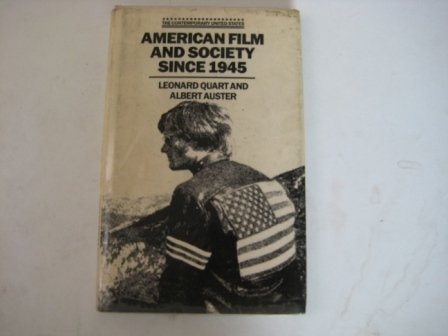
American film and society since 1945 (The Contemporary United States)
0
0
As an Amazon Associate and affiliate partner, Menrva Books earns from qualifying purchases. Learn more
Author Description
Although films rarely act as mirror reflections of everyday reality, they are, nevertheless, powerful cultural expressions of the dreams and desires of the American public. In the third edition of their seminal work, Leonard Quart and Albert Auster provide a complete post-World War II survey of American cinema and its often complex and contradictory values. From the self-confident affirmations of the immediate postwar era, through the social and cinematic turbulence of the sixties and seventies, to the darker, more pessimistic works of the nineties, America cinema has reflected and refracted American concerns. While adhering to the chronological structure and critical premises of the previous editions, American Film and Society Since 1945, Third Edition, adds key analyses of post-Cold War and Clinton-era cinema. While films of the nineties evoked no single political or cultural current, their diversity provides a panoramic view of this most complicated time. Movies that reaffirmed American patriotism (Saving Private Ryan) and debunked its politics (Bulworth), explored life in the inner city (Boyz N the Hood), dealt with homosexuality (Philadelphia), women's issues (Thelma & Louise), suburbia (American Beauty), and sexuality (Eyes Wide Shut) add up to a decade as multifaceted as any that Quart and Auster have considered. No other work provides such an exhaustive and rigorous account of this parallel history of the United States. The breadth and depth of this latest edition will hold appeal for scholars, students, and general readers alike.
Menrva's Summary
THE THESIS
How does American cinema function as a cultural barometer for the shifting social, political, and economic values of the United States from 1945 to the present? Leonard Quart and Albert Auster, both established scholars in film and cultural history, utilize a chronological framework to examine the relationship between cinematic output and the American zeitgeist. By analyzing specific films as artifacts of their time, the authors argue that movies serve as complex reflections of national identity, anxieties, and aspirations throughout the post-World War II era.
THE SCOPE MAP
What You Will Find
- A chronological survey of American film history from the post-WWII era through the Clinton administration.
- Critical analysis of thematic shifts in cinema, including patriotism, social turbulence, and suburban malaise.
- Case studies of influential films such as Saving Private Ryan, Bulworth, and American Beauty.
Scope Limits
- The text focuses primarily on mainstream American cinema rather than experimental or international film movements.
- The analysis is bounded by the historical period ending in the late 1990s and does not cover contemporary digital-era developments.
THE AUTHORITY PERSPECTIVE
Experts and academics frequently cite this work as a foundational text for understanding the intersection of popular culture and historical change. Readers often note the accessible yet rigorous nature of the prose, making it a standard resource for students of both film history and American studies.
Page Count:
156
Publication Date:
1984-01-01
Publisher:
Macmillan
ISBN-10:
0030012694
ISBN-13:
9780030012693
Politics
Criticism history
Film Studies
Cinema History
Humor & Entertainment
Movies
Sociology
American History
Reference