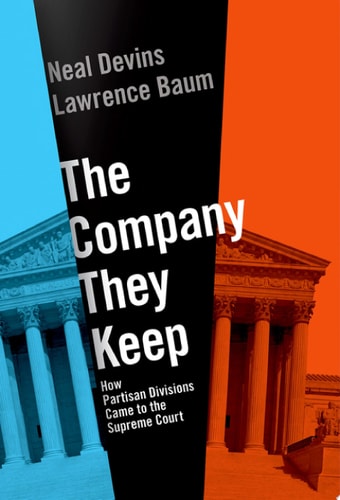
The Company They Keep
0
0
As an Amazon Associate and affiliate partner, Menrva Books earns from qualifying purchases. Learn more
Author Description
Are Supreme Court Justices Swayed By The Political Environment That Surrounds Them? Most People Think Yes, And They Point To The Influence Of The General Public And The Other Branches Of Government On The Court. It Is Not That Simple, However. As The Eminent Law And Politics Scholars Neal Devins And Lawrence Baum Show In The Company They Keep, Justices Today Are Reacting Far More To Subtle Social Forces In Their Own Elite Legal World Than To Pressure From The Other Branches Of Government Or Mass Public Opinion. In Particular, The Authors Draw From Social Psychology Research To Show Why Justices Are Apt To Follow The Lead Of The Elite Social Networks That They Are A Part Of. The Evidence Is Strong: Justices Take Cues Primarily From The People Who Are Closest To Them And Whose Approval They Care Most About: Political, Social, And Professional Elites. In An Era Of Strong Partisan Polarization, Elite Social Networks Are Largely Bifurcated By Partisan And Ideological Loyalties, And The Justices Reflect That Division. The Result Is A Court In Which The Justices' Ideological Stances Reflect The Dominant Views In The Appointing President's Party. Justices Such As Clarence Thomas And Ruth Bader Ginsburg Live Largely In A Milieu Populated By Like-minded Elites. Today's Partisanship On The Court Also Stems From The Emergence Of Conservative Legal Networks Such As The Federalist Society, That Reinforce The Conservative Leanings Of Republican Appointees. For The Warren And Burger Courts, Elite Social Networks Were Dominated By Liberal Elites And Not Divided By Political Party Or Ideology. A Fascinating Examination Of The Factors That Shape Decision-making, The Company They Keep Will Reshape Our Understanding Of How Political Polarization Occurs On The Contemporary Supreme Court.
Menrva's Summary
THE THESIS
This book investigates whether Supreme Court Justices are primarily influenced by external political pressures or by the internal social networks they inhabit. Authors Neal Devins and Lawrence Baum, both established scholars in law and politics, utilize social psychology frameworks to argue that Justices are significantly more responsive to the elite social circles they frequent than to public opinion or direct pressure from other branches of government. They contend that in a polarized era, these bifurcated elite networks reinforce ideological consistency among the Justices.
THE SCOPE MAP
What You Will Find
- Analysis of the influence of elite social networks on judicial decision-making.
- Application of social psychology research to the behavior of Supreme Court Justices.
- Comparative study of the Warren and Burger Courts versus the contemporary Court.
- Examination of the role of organizations like the Federalist Society in shaping judicial ideology.
Scope Limits
- The book does not provide an exhaustive legal analysis of every Supreme Court case.
- It does not focus on the personal lives of the Justices outside of their professional and social elite spheres.
THE AUTHORITY PERSPECTIVE
Legal scholars and political scientists frequently cite this work as a significant contribution to understanding the social dynamics of the judiciary. Experts highlight the authors' ability to bridge the gap between social psychology and constitutional law to explain modern judicial polarization.
Page Count:
240
Publication Date:
2019-01-01
Publisher:
Oxford University Press
ISBN-10:
0190278064
ISBN-13:
9780190278069
Sociology
Supreme Court
Law
American Government
Community Tags
Similar Books