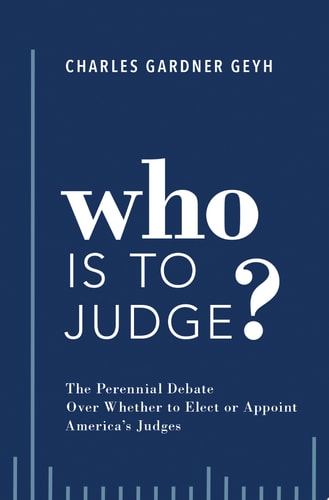
Who Is to Judge?: The Perennial Debate Over Whether to Elect or Appoint America's Judges
0
0
As an Amazon Associate and affiliate partner, Menrva Books earns from qualifying purchases. Learn more
Author Description
An elected judiciary is virtually unique to the American experience and creates a paradox in a representative democracy. Elected judges take an oath to uphold the law impartially, which calls upon them to swear off the influence of the very constituencies they must cultivate in order to attain and retain judicial office. This paradox has given rise to perennially shrill and unproductive binary arguments over the merits and demerits of elected and appointed judiciaries, which this project seeks to transcend and reimagine. In Who Is to Judge?, judicial politics expert Charles Gardner Geyh exposes and explains the overstatements of both sides in the judicial selection debate. When those exaggerations are understood as such, it becomes possible to search for common ground and its limits. Ultimately, this search leads Geyh to conclude that, while appointive systems are a preferable default, no one system of selection is best for all jurisdictions at all times.
Menrva's Summary
THE THESIS
This book investigates the fundamental paradox of the American judiciary, specifically questioning whether elected or appointed systems better serve the requirements of a representative democracy. Charles Gardner Geyh, a recognized expert in judicial politics, utilizes historical analysis and contemporary political data to deconstruct the binary arguments surrounding judicial selection. He argues that both sides of the debate rely on significant overstatements, and he proposes a nuanced framework that seeks common ground while acknowledging the limitations of any single selection model.
THE SCOPE MAP
What You Will Find
- A comparative analysis of elected versus appointed judicial systems in the United States.
- An examination of the inherent conflicts between judicial impartiality and political campaigning.
- A critical evaluation of the arguments used by proponents and opponents of various selection methods.
Scope Limits
- The book does not provide a universal blueprint for judicial reform across all states.
- It does not focus on the specific legal rulings of individual judges, but rather on the systems that place them in office.
THE AUTHORITY PERSPECTIVE
Legal scholars and political scientists view this work as a balanced, objective contribution to the study of American judicial administration. Experts highlight the text for its ability to move beyond partisan rhetoric to provide a clear-eyed assessment of the practical trade-offs involved in judicial selection.
Page Count:
216
Publication Date:
2019-03-14
Publisher:
Oxford University Press
ISBN-10:
0190887141
ISBN-13:
9780190887148
American Government
Judges
Judicial System
Law
Professional Career & Trade
Public Policy
Community Tags
Similar Books