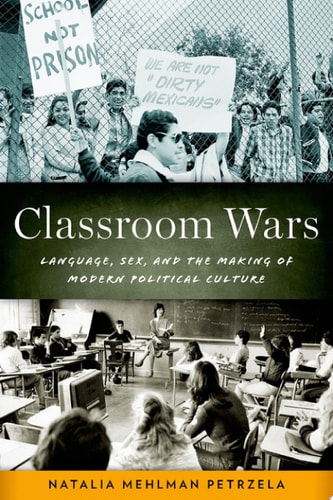
Classroom Wars: Language, Sex, and the Making of Modern Political Culture
0
0
As an Amazon Associate and affiliate partner, Menrva Books earns from qualifying purchases. Learn more
Author Description
The schoolhouse has long been a crucible in the construction and contestation of the political concept of "family values." Through Spanish-bilingual and sex education, moderates and conservatives in California came to define the family as a politicized and racialized site in the late 1960s and 1970s. Sex education became a vital arena in the culture wars as cultural conservatives imagined the family as imperiled by morally lax progressives and liberals who advocated for these programs attempted to manage the onslaught of sexual explicitness in broader culture. Many moderates, however, doubted the propriety of addressing such sensitive issues outside the home. Bilingual education, meanwhile, was condemned as a symbol of wasteful federal spending on ethically questionable curricula and an intrusion on local prerogative. Spanish-language bilingual-bicultural programs may seem less relevant to the politics of family, but many Latino parents and students attempted to assert their authority, against great resistance, in impassioned demands to incorporate their cultural and linguistic heritage into the classroom. Both types of educational programs, in their successful implementation and in the reaction they inspired, highlight the rightward turn and enduring progressivism in postwar American political culture.In Classroom Wars, Natalia Mehlman Petrzela charts how a state and a citizenry deeply committed to public education as an engine of civic and moral education navigated the massive changes brought about by the 1960s, including the sexual revolution, school desegregation, and a dramatic increase in Latino immigration. She traces the mounting tensions over educational progressivism, cultural and moral decay, and fiscal improvidence, using sources ranging from policy documents to student newspapers, from course evaluations to oral histories. Petrzela reveals how a growing number of Americans fused values about family, personal, and civic morality, which galvanized a power
Menrva's Summary
THE THESIS
This book investigates how the implementation of sex education and Spanish-bilingual programs in California schools during the 1960s and 1970s transformed the classroom into a central battleground for American political culture. Natalia Mehlman Petrzela, a historian of education and politics, utilizes a diverse array of primary sources—including policy documents, student newspapers, and oral histories—to analyze how these educational initiatives became flashpoints for debates over family values, racial identity, and the role of government. She argues that these local school conflicts were instrumental in shaping the broader rightward shift and the persistent progressive tensions within postwar American society.
THE SCOPE MAP
What You Will Find
- Analysis of the political and cultural impact of sex education and bilingual-bicultural curricula in California.
- Examination of the intersection between school desegregation, Latino immigration, and the sexual revolution.
- Utilization of primary source materials ranging from official policy documents to personal oral histories.
- Exploration of how the concept of 'family values' was constructed and contested within the public school system.
THE AUTHORITY PERSPECTIVE
Scholars and historians recognize this work as a significant contribution to the study of postwar American political culture and the history of education. Readers frequently note the meticulous archival research and the clarity with which the author connects local school board disputes to national ideological trends.
Page Count:
336
Publication Date:
2015-01-01
Publisher:
Oxford University Press
ISBN-10:
0199358478
ISBN-13:
9780199358472
History
Educational Foundations
Education
Educational Reform
Professional Career & Trade
Modern History
United States
Special Topics
American History
Sociology
Bilingual Education
Community Tags
Other Editions(2)
Similar Books



Reader Comments
Share Your Thoughts
No comments yet. Be the first to share your thoughts!