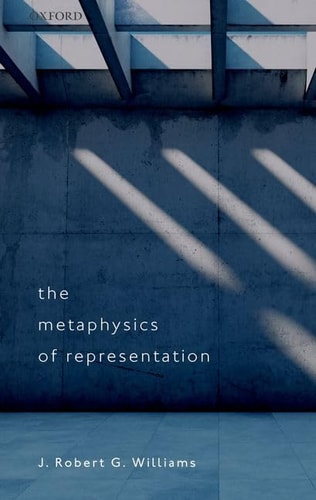
The Metaphysics of Representation
0
0
As an Amazon Associate and affiliate partner, Menrva Books earns from qualifying purchases. Learn more
Author Description
Representing the world is a puzzling thing. How can it be that mundane events such as processing a thought--and from there putting those thoughts into words--acquire this property of 'aboutness'? How can expressions, which depend on anything from the most fundamental regularities in the universe to trivial matters of gossip, be either true or false? In The Metaphysics of Representation, J. Robert G. Williams tells a story about how representational properties arise out of a fundamentally non-representational world. The representational properties of language are reduced, via convention, to the representational properties of thoughts. The representational properties of thoughts are reduced, via principles of rationalization, to the representational properties of perception and intention. And this most fundamental layer of representation is explained in terms of the functions they have to communicate. Williams integrates work from rival traditions to present a combined perspective in the metaphysics of representation, give new predictions and explanations of representational phenomena, and offer new solutions to long-standing problems.
Menrva's Summary
THE THESIS
How can representational properties, such as the 'aboutness' of thoughts and language, emerge from a fundamentally non-representational physical world? J. Robert G. Williams, a philosopher specializing in metaphysics and the philosophy of language, constructs a reductive framework that traces the origins of representation from linguistic convention down to the functional roles of perception and intention. By integrating disparate philosophical traditions, the author provides a systematic account of how truth-apt expressions arise from basic physical regularities.
THE SCOPE MAP
What You Will Find
- A reductive hierarchy linking language, thought, perception, and intention.
- Analysis of the role of convention in linguistic representation.
- Application of rationalization principles to mental states.
- Functionalist explanations of fundamental representational layers.
Scope Limits
- The text does not provide an exhaustive survey of every historical theory of representation.
- It does not address non-cognitive or purely emotive forms of expression in detail.
THE AUTHORITY PERSPECTIVE
Experts recognize this work as a rigorous contribution to contemporary analytic metaphysics that successfully bridges gaps between rival schools of thought. Readers frequently note the high level of technical density in the prose, making it most suitable for advanced students and professional philosophers.
Page Count:
240
Publication Date:
2022-04-30
Publisher:
Oxford University Press
ISBN-10:
0192864696
ISBN-13:
9780192864697
Politics
Philosophy
New Used & Rental Textbooks
Mind & Body
Ontology
Metaphysics
Representation Philosophy
Philosophy of
Consciousness & Thought
Epistemology
Community Tags
Other Editions(3)
Similar Books