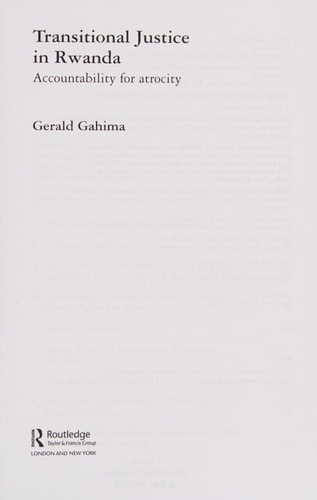
Transitional justice in Rwanda: accountability for atrocity
0
0
As an Amazon Associate and affiliate partner, Menrva Books earns from qualifying purchases. Learn more
Author Description
Comprehensively Analyzes The Full Range Of The Transitional Justice Processes Undertaken For The Rwandan Genocide. Drawing On The Author's Extensive Professional Experience As The Principal Justice Policy Maker And The Leading Law Enforcement Officer In Rwanda From 1996-2003, The Book Provides An In-depth Analysis Of The Social, Political And Legal Challenges Faced By Rwanda In The Aftermath Of The Genocide And The Aspirations And Legacy Of Transitional Justice. The Book Explores The Role Played By The Accountability Processes Not Just In Pursuing Accountability But Also In Shaping The Reconstruction Of Rwanda's Institutions Of Democratic Governance And Political Reconciliation. Central To This Exploration Will Be The Examination Of Whether Or Not Transitional Justice In Rwanda Has Contributed To A Foundational Rule Of Law Reform Process--p. [4] Of Cover. Theoretical Framework Of Transitional Justice -- A Decade Of Atrocities -- Accountability For Mass Atrocity Challenges Choices And Goals Of Transitional Justice In Rwanda -- Accountability, Justice And The Role Of The International Criminal Tribunal For Rwanda -- National Prosecutions -- Seeking Alternative Accountability Mechanisms -- Trials Based On Universal Jurisdiction -- Untold Story, Unfinished Business -- Confronting The Crimes Of The Victors -- Assessing The Impact And Legacy Of Rwanda's Processes Of Accountability For Atrocity -- Tentative Lessons From Rwanda's Mechanisms Of Accountability For Atrocity -- Conclusion. Gerald Gahima. Includes Bibliographical References (p. [331]-368) And Index.
Menrva's Summary
THE THESIS
This book investigates the efficacy and long-term impact of transitional justice mechanisms implemented in Rwanda following the 1994 genocide. Drawing on his direct experience as a principal justice policy maker and law enforcement official in Rwanda between 1996 and 2003, Gerald Gahima provides a critical assessment of the legal, social, and political hurdles encountered during the nation's reconstruction. The work evaluates how various accountability processes, ranging from international tribunals to local mechanisms, influenced the development of democratic governance and the rule of law within the country.
THE SCOPE MAP
What You Will Find
- Analysis of the International Criminal Tribunal for Rwanda and its operational limitations.
- Examination of national prosecution strategies and alternative accountability mechanisms like Gacaca courts.
- Discussion of universal jurisdiction trials and their role in addressing mass atrocities.
- Assessment of the political challenges regarding the prosecution of crimes committed by victors.
- Evaluation of the broader legacy of justice processes on Rwanda's institutional reform.
THE AUTHORITY PERSPECTIVE
Experts recognize this work as a primary source for understanding the practical application of transitional justice in a post-conflict state. Readers frequently note the author's unique vantage point as a former government official, which provides a level of institutional insight rarely found in external academic accounts.
Page Count:
387
Publication Date:
2013-01-01
Publisher:
Routledge
ISBN-10:
0203075153
ISBN-13:
9780203075159
History
Human rights
Africa
War Crime Trials
Law