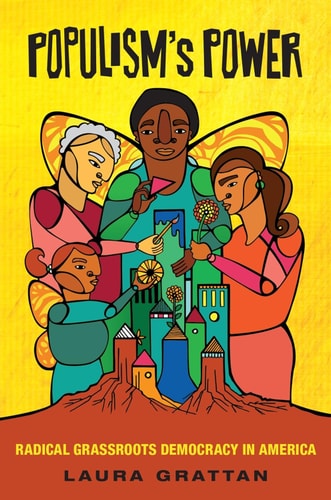
Populism's Power: Radical Grassroots Democracy in America
0
0
As an Amazon Associate and affiliate partner, Menrva Books earns from qualifying purchases. Learn more
Author Description
Uprisings such as the Tea Party and Occupy Wall Street signal a resurgence of populist politics in America, pitting the people against the establishment in a struggle over control of democracy. In the wake of its conservative capture during the Nixon and Reagan eras, and given its increasing ubiquity as a mainstream buzzword of politicians and pundits, democratic theorists and activists have been eager to abandon populism to right-wing demagogues and mega-media spin-doctors. Decades of liberal scholarship have reinforced this shift, turning the term "populism" into a pejorative in academic and public discourse. At best, they conclude that populism encourages an "empty" wish to express a unified popular will beyond the mediating institutions of government; at worst, it has been described as an antidemocratic temperament prone to fomenting backlash against elites and marginalized groups.Populism's Power argues that such routine dismissals of populism reinforce liberalism as the end of democracy. Yet, as long as democracy remains true to its meaning, that is, "rule by the people," democratic theorists and activists must be able to give an account of the people as collective actors. Without such an account of the people's power, democracy's future seems fixed by the institutions of today's neoliberal, managerial states, and not by the always changing demographics of those who live within and across their borders. Laura Grattan looks at how populism cultivates the aspirations of ordinary people to exercise power over their everyday lives and their collective fate. In evaluating competing theories of populism she looks at a range of populist moments, from cultural phenomena such as the Chevrolet ad campaign for "Our Country, Our Truck," to the music of Leonard Cohen, and historical and contemporary populist movements, including nineteenth-century Populism, the Tea Party, broad-based community organizing, and Occupy Wall Street. While she ultimately expresses ambivalence a
Menrva's Summary
THE THESIS
How can democratic theorists and activists reclaim the concept of populism as a constructive force for collective action rather than dismissing it as inherently antidemocratic? Laura Grattan, a scholar of political theory, challenges the prevailing liberal academic consensus that views populism solely as a pejorative term associated with demagoguery. By examining the historical and contemporary manifestations of populist movements, she argues that populism is a vital mechanism for ordinary people to assert control over their collective fate and everyday lives within the constraints of modern neoliberal states.
THE SCOPE MAP
What You Will Find
- Analysis of historical populist movements including nineteenth-century agrarian populism.
- Examination of contemporary phenomena such as the Tea Party and Occupy Wall Street.
- Cultural critique of populist themes in media, including advertising and music.
- Theoretical evaluation of populism as a tool for democratic engagement.
Scope Limits
- The text does not provide a prescriptive manual for organizing modern political movements.
- It does not offer a definitive resolution to the inherent tensions between populist fervor and institutional stability.
THE AUTHORITY PERSPECTIVE
Scholars and political theorists recognize this work as a significant intervention in the study of democratic movements, noting its success in deconstructing the negative biases surrounding populist rhetoric. Readers frequently highlight the author's ability to bridge the gap between abstract political theory and tangible cultural examples.
Page Count:
304
Publication Date:
2016-02-03
Publisher:
Oxford University Press
ISBN-10:
0190277637
ISBN-13:
9780190277635
American History
Sociology
Populism
Democracy
Political Theory
Community Tags
Similar Books