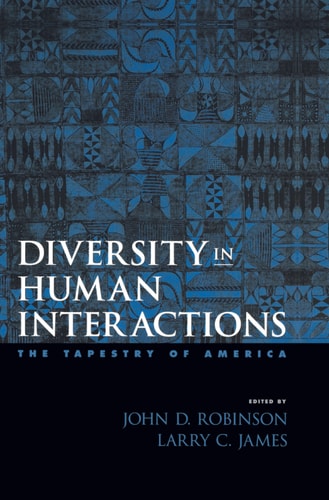
Diversity in Human Interactions: The Tapestry of America
0
0
As an Amazon Associate and affiliate partner, Menrva Books earns from qualifying purchases. Learn more
Author Description
When people who interact do not share the same abilities, orientations, or beliefs, the results are often disastrous, leaving everyone involved feeling misunderstood, underappreciated, and resentful. Why does this happen? How can we find and focus on the strengths in our differences, rather than the weaknesses? How can we accept that our differences bring with them different ways of looking at a problem, and that these different ways of looking at things lead to unique, and sometimes conflicting, solutions to problems?In this volume, editors John D. Robinson and Larry C. James have assembled renowned leaders, scholars, and educators in order to show how these differences can facilitate, not hinder, our progress. They provide thought-provoking and insightful essays about how having different physical abilities, sexual orientations, races, and religions affects how people interact. Each chapter is written by a member of a different group and presents real-life stories about interactions within that group. The universality of these stories allows the reader to empathize with diverse points of view, generating material for group discussion and debate. The book's aim is to enrich interactions among different types of people by exploring how our differences can shape our perceptions of events in particular and life in general by focusing on the strengths in our diversity, rather than the conflicts brought about by it.
Menrva's Summary
THE THESIS
This volume investigates how diverse human identities—including race, religion, physical ability, and sexual orientation—influence interpersonal communication and conflict resolution. Editors John D. Robinson and Larry C. James, both established scholars in psychology and human relations, curate a collection of essays from various experts to argue that perceived differences should be leveraged as cognitive strengths rather than sources of friction. The text utilizes a framework of personal narrative and academic analysis to demonstrate how varied perspectives can lead to more robust problem-solving outcomes.
THE SCOPE MAP
What You Will Find
- Essays covering intersections of race, religion, sexual orientation, and physical ability.
- Real-life case studies and personal narratives from members of diverse demographic groups.
- Methodologies for reframing interpersonal conflict as a byproduct of differing worldviews.
Scope Limits
- The text does not provide a comprehensive legislative or policy-based analysis of diversity.
- It does not offer a singular, universal solution for all types of interpersonal prejudice.
THE AUTHORITY PERSPECTIVE
Experts and educators frequently utilize this text as a foundational resource for facilitating group discussions on social dynamics and empathy. Readers often note that the inclusion of diverse personal narratives makes the academic concepts accessible for both classroom settings and professional development workshops.
Page Count:
234
Publication Date:
2003-01-01
Publisher:
Oxford University Press
ISBN-10:
0190286792
ISBN-13:
9780190286798
English
Medical
Allied Health
Sociology
Diversity and Inclusion
Linguistics
Human Relations
English & College Success
United States
Community Tags
Similar Books