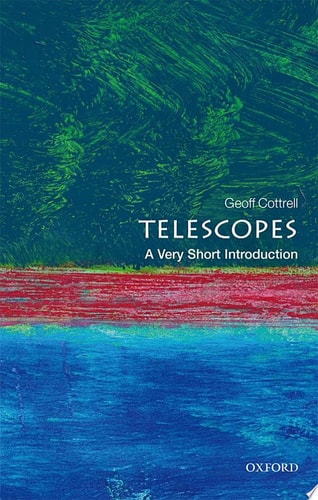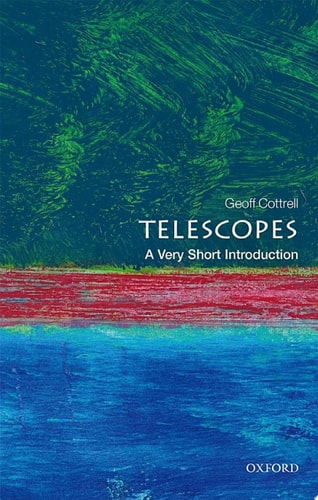
Telescopes: A Very Short Introduction
0
0
As an Amazon Associate and affiliate partner, Menrva Books earns from qualifying purchases. Learn more
Author Description
From the first, telescopes have made dramatic revelations about the Universe and our place in it. Galileo's observations of the Moon's cratered surface and discovery of Jupiter's four big satellites profoundly altered the perception of the heavens, overturning a two-thousand year cosmology that held the Earth to be the centre of the Universe. Over the past century, the rapid development of computer technology and sophisticated materials allowed enormous strides in the construction of telescopes. Modern telescopes range from large Earth-based optical telescopes and radio arrays linking up across continents, to space-based telescopes capturing the Universe in infrared, ultraviolet, X-rays, and gamma rays. In combination, they have enabled us to look deep into the Universe and far back in time, capturing phenomena from galactic collisions to the formation of stars and planetary systems, and mapping the faint glow remaining from the Big Bang. In this Very Short Introduction, Dr. Geoff Cottrell describes the basic physics of telescopes, the challenges of overcoming turbulence and distortion from the Earth's atmosphere, and the special techniques used to capture X-rays and gamma rays in space telescopes. He explains the crucial developments in detectors and spectrographs that have enabled the high resolution achieved by modern telescopes, and the hopes for the new generation of telescopes currently being built across the world. ABOUT THE SERIES: The Very Short Introductions series from Oxford University Press contains hundreds of titles in almost every subject area. These pocket-sized books are the perfect way to get ahead in a new subject quickly. Our expert authors combine facts, analysis, perspective, new ideas, and enthusiasm to make interesting and challenging topics highly readable.
Menrva's Summary
THE THESIS
This book investigates the evolution of telescope technology and the fundamental physical principles that allow these instruments to reveal the structure and history of the universe. Dr. Geoff Cottrell, an expert in the field, utilizes his background in astrophysics to synthesize the history of observational astronomy with the technical mechanics of modern instrumentation. The text argues that the progression from simple optical lenses to complex, multi-spectrum space arrays has fundamentally redefined human understanding of cosmic phenomena.
THE SCOPE MAP
What You Will Find
- Historical overview of telescope development from Galileo to modern radio arrays
- Explanation of basic optical physics and atmospheric distortion challenges
- Technical breakdown of detectors, spectrographs, and space-based X-ray/gamma-ray capture methods
- Analysis of current and future telescope projects
Scope Limits
- Does not provide exhaustive mathematical derivations for advanced optical engineering
- Does not cover the entirety of cosmological theory beyond the role of observational tools
THE AUTHORITY PERSPECTIVE
Readers frequently note the accessible yet technically rigorous nature of this introduction, which serves as an effective primer for students and enthusiasts. Experts highlight this as a concise, reliable reference for understanding the hardware that drives contemporary astronomical discovery.
Page Count:
144
Publication Date:
2016-01-01
Publisher:
OUP Oxford
ISBN-10:
0191063010
ISBN-13:
9780191063015
Science
Non-Fiction
Reference
Introductory Astronomy
Earth Sciences
Physics
Astronomy
Technology