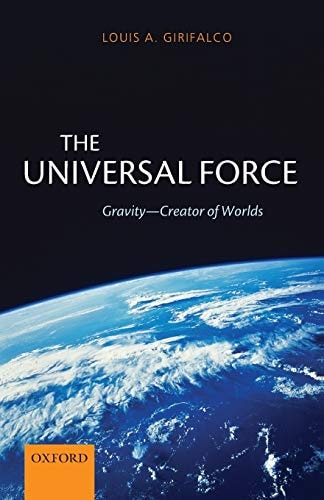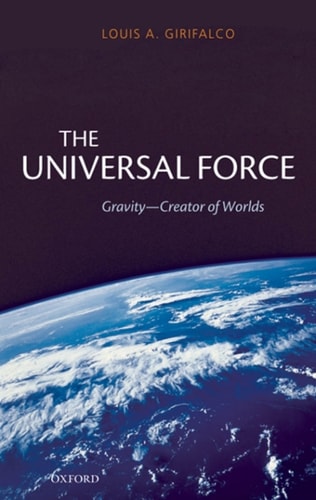
The Universal Force: Gravity - Creator of Worlds
0
0
As an Amazon Associate and affiliate partner, Menrva Books earns from qualifying purchases. Learn more
Author Description
The Universal Force conveys the excitement of science and nature's mysteries. It describes gravitation as seen by examining the achievements of those great scientists who have struggled with the seemingly simple facts and managed to extract some truth about the nature of gravity, its origins, and its effects. Gravity is intimately tied up with motion, and therefore with time and space, and is responsible for planetary systems, the evolution of stars and the existence of black holes and the very beginning of the Universe. It is the universal force, and to look at gravity is to look at the deepest aspects of nature. The historical context from Aristotle's teleology through Galileo's conflict with the Church, to Newton's law, and Einstein's curved space time, displays the evolution of the science of gravity as one of the greatest and most fascinating human achievements. Contrary to popular opinion, all important science can be understood by anyone, with or without a scientific background. This book shows that the beauty and mysteries of science can be shared with everyone.
Menrva's Summary
THE THESIS
How does the historical and scientific understanding of gravity reveal the fundamental nature of the universe and our place within it? Louis A. Girifalco, a physicist and educator, synthesizes the evolution of gravitational theory to demonstrate that complex scientific concepts are accessible to a general audience. By tracing the intellectual progression from classical mechanics to modern relativity, the author argues that gravity serves as the primary architect of cosmic structure, time, and space.
THE SCOPE MAP
What You Will Find
- Historical progression of gravitational theory from Aristotle to Einstein.
- Explanations of planetary motion, stellar evolution, and black hole formation.
- Conceptual links between gravity, time, and the origins of the universe.
Scope Limits
- The text does not provide advanced mathematical proofs or technical derivations for professional physicists.
- It does not focus on quantum gravity or the latest developments in string theory.
THE AUTHORITY PERSPECTIVE
Readers frequently note the clarity of the prose and the author's ability to distill complex physical concepts for a lay audience. Experts highlight this as a useful introductory text for those interested in the historical development of physics and the conceptual foundations of cosmology.
Page Count:
288
Publication Date:
2007-01-01
Publisher:
Oxford University Press
ISBN-10:
0191527971
ISBN-13:
9780191527975
Science
Physics
Cosmology
Earth Sciences
Modern Physics
Science History
Astronomy