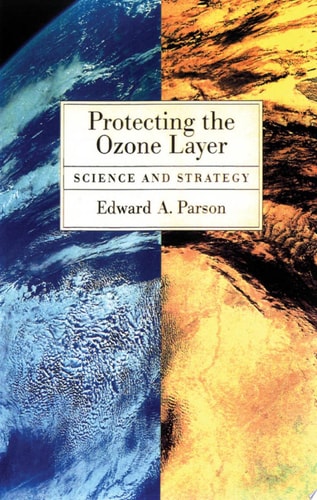
Protecting the Ozone Layer: Science and Strategy
0
0
As an Amazon Associate and affiliate partner, Menrva Books earns from qualifying purchases. Learn more
Author Description
This book is the first comprehensive history of international efforts to protect the ozone layer, the greatest success yet achieved in managing human impacts on the global environment. Its arguments about how this success was achieved are both theoretically novel and of great significance for the management of other global problems, particularly global climate change. The book provides an account of the ozone-depletion issues from the first attempts to develop international action in the 1970s to the mature functioning of the present international regime. It examines the parallel developments of politics and negotiations, scientific understanding and controversy, technological progress, and industry strategy that shaped the issue's development and its effective management. In addition, the book offers important new insights into how the interactions among these domains influenced the formation and adaptation of the ozone regime. Addressing the initial formation of the regime, the book argues that authoritative scientific assessments were crucial in constraining policy debates and shaping negotiated agreements. Assessments gave scientific claims an ability to change policy actors' behavior that the claims themselves, however well known and verified, lacked. Concerning subsequent adaptation of the regime, the book identifies a series of feedbacks between the periodic revision of chemical controls and the strategic responses of affected industries, which drove rapid application of new approaches to reduce ozone-depleting chemicals. These feedbacks, promoted by the regime's novel technology assessment process, allowed worldwide use of the chemicals to decline further and faster than even the boldest predictions, by nearly 95 percent within ten years.
Menrva's Summary
THE THESIS
This book investigates the mechanisms behind the successful international management of ozone depletion to determine how global environmental cooperation can be effectively structured. Edward A. Parson, an expert in environmental policy, synthesizes historical data and political analysis to argue that the interaction between scientific assessment and industrial strategy was the primary driver of the ozone regime's success. He posits that authoritative scientific assessments functioned as a catalyst for policy change, while feedback loops between chemical controls and industrial innovation accelerated the phase-out of harmful substances.
THE SCOPE MAP
What You Will Find
- A historical account of international ozone protection efforts from the 1970s to the present.
- An analysis of the technology assessment process used to drive industrial compliance.
- Examination of the interplay between scientific controversy, political negotiation, and technological progress.
Scope Limits
- The text focuses primarily on the ozone regime and does not provide a comprehensive manual for managing other environmental issues.
- It does not offer a technical scientific guide to ozone chemistry, focusing instead on the policy and management aspects.
THE AUTHORITY PERSPECTIVE
Experts recognize this work as a foundational analysis of international environmental governance and the efficacy of the Montreal Protocol. Readers frequently note the academic density of the prose, which provides a rigorous framework for understanding how policy regimes adapt to scientific and industrial shifts.
Page Count:
394
Publication Date:
2003-01-01
Publisher:
Oxford University Press
ISBN-10:
019028871X
ISBN-13:
9780190288716
History
Public Policy
International relations
Community Tags
Similar Books