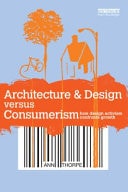
Architecture and Design Versus Consumerism
0
0
As an Amazon Associate and affiliate partner, Menrva Books earns from qualifying purchases. Learn more
Author Description
The mentality that consumerism and economic growth are cure-alls is one of the biggest obstacles to real sustainability, but any change seems impossible, unthinkable. Our contemporary paradox finds us relying for our well being on consumer-driven economic growth that we actually can't afford -- not in environmental, economic or social terms. Although architecture and design have long been seen as engines for consumerism and growth, increasing numbers of designers are concerned about the problems resulting from growth. But designers face a paradox of their own; in scenarios of sustainable consumption, where people consume or build significantly less, what will be left for designers to do? This book, informed by recent research into the viability of a "steady state" economy, sets an agenda for addressing the designer's paradox of sustainable consumption. The agenda includes ways that architecture and design can help transition us towards a new kind of economy that prioritizes real wellbeing rather than economic growth. Packed with examples and illustrations, the book argues that taking action, or activism, is an important but so far underexplored way for architects and designers to confront consumerism. The first chapters explore how economic growth and consumerism shape and are shaped by the professions of architecture, product, and landscape design and how we can understand the problem of consumerism as four main challenges that designers are already addressing. The book maps out the main issues surrounding the development of metrics that designers and others can use to measure wellbeing, instead of simply measuring economic growth. The second half of the book looks at how design activism works and its connection to growth and consumerist issues. These chapters examine how activist practices are financed, highlight five specific methods that designers use in working for social change, and investigate the power of these methods.
Menrva's Summary
THE THESIS
This book investigates how architecture and design can pivot from serving consumer-driven economic growth to fostering a sustainable, steady-state economy that prioritizes human wellbeing. Author Ann Thorpe, an expert in sustainable design and social change, utilizes research into economic viability to challenge the traditional role of designers as engines of consumption. She argues that by adopting activist practices, professionals in architecture, product design, and landscape design can actively dismantle the paradox of needing growth for wellbeing while facing the environmental costs of that same growth.
THE SCOPE MAP
What You Will Find
- An analysis of how economic growth dictates the professional practices of architects and designers.
- A framework for transitioning from growth-based metrics to wellbeing-focused measurement systems.
- An investigation into five specific methods of design activism used to influence social and economic change.
- Case studies and illustrations demonstrating how designers can operate within a steady-state economic model.
THE AUTHORITY PERSPECTIVE
Experts identify this work as a critical intervention for practitioners seeking to reconcile professional output with environmental limits. Readers frequently note the clarity with which the text bridges complex economic theory and practical design application.
Page Count:
0
Publication Date:
2012-01-01
Publisher:
Taylor & Francis Group
ISBN-10:
0203119517
ISBN-13:
9780203119518
Economics
Architecture
Social Aspects
Sustainable architecture
Social Action
Consumption Economics
Design
Social change
Architecture and society
Architecture
Sustainability
Community Tags
Other Editions(2)
Similar Books











Reader Comments
Share Your Thoughts
No comments yet. Be the first to share your thoughts!